 King County
 Bothell's Climate Asks More of a Deck Than People Expect
Bothell sits in that stretch of King County where marine air off Puget Sound meets inland weather patterns — the result is long stretches of driving rain, heavy fall and winter humidity, and a moss season that can run from October well into spring. A deck here isn't just outdoor furniture space. It's a structure that spends most of the year damp, shaded by mature trees on many lots, and exposed to wind-driven rain that gets up underneath railings and ledger boards where you can't see it.
Composite decking earns its reputation in this climate because it doesn't absorb water the way wood does, doesn't need annual staining, and won't cup, splinter, or rot from repeated wet-dry cycles. But composite is only as good as the substructure and installation underneath it. We've seen composite boards installed over framing that was never properly flashed or ventilated, and within a few years the homeowner has moisture damage under a deck surface that was supposed to be maintenance-free.
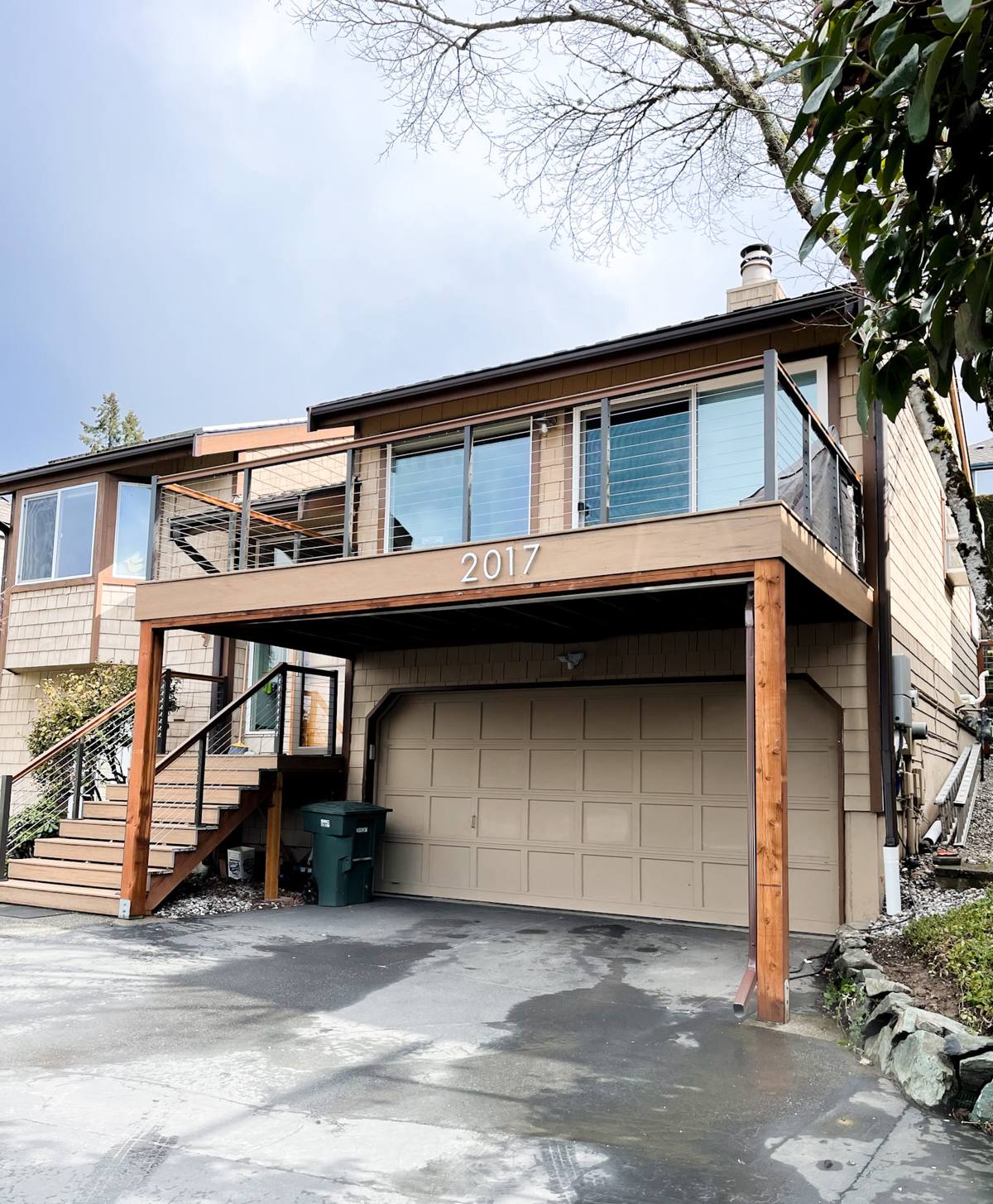
What Bothell Homes Specifically Need From a Composite Deck
Drainage First, Boards Second
The single biggest factor in how long a deck lasts in this area is what happens to water once it hits the surface and works its way down through gaps and fasteners. A correct installation assumes water will get underneath the boards — because in King County's rain volume, it will — and gives that water somewhere to go.
Moss and Algae Resistance
Shaded, north-facing, or tree-covered lots around Bothell grow moss on almost any horizontal surface that stays damp. Composite decking varies quite a bit in how it handles this: capped composite boards with a solid polymer shell resist moss and mildew staining far better than uncapped or lower-grade composite, which can develop a slightly porous surface over time that gives algae something to grip.
Fastener and Hardware Corrosion
Salt-tinged marine air moving inland off the Sound accelerates corrosion on cheap fasteners and hidden clip systems. Stainless or coated hardware rated for coastal exposure isn't optional here — it's the difference between hidden fasteners that hold for the life of the deck and ones that streak, loosen, or fail within a few seasons.
What a Correct Composite Deck Installation Actually Involves
- Ledger board flashing that properly sheds water away from the house rim joist, not just a bead of caulk
- Joist tape over every framing member the decking will contact, protecting wood substructure from the moisture that migrates through composite board gaps
- Correct joist spacing for the specific composite product — many boards require tighter spacing than traditional lumber, especially on diagonal patterns or stairs
- Ventilation gaps at the deck perimeter and any skirting, so air can move underneath and dry out framing after rain
- Proper fastener spacing and hidden clip installation per the manufacturer's actual spec, not a generalized "composite" approach
- Picture-frame or border boards installed with expansion gaps, since composite moves with temperature more than people expect
Skipping any one of these doesn't show up on day one. It shows up two or three winters in, when the framing underneath has been trapping moisture the whole time and the homeowner is dealing with soft spots or a spongy feel near the ledger — problems that are expensive to fix because they require pulling the deck surface to get at the structure.
Comparing Composite Board Types for a Wet Climate
| Board Type | Moisture Behavior | Moss/Algae Resistance | Typical Maintenance |
|---|---|---|---|
| Capped composite (polymer shell) | Excellent — shell blocks water absorption into the core | High — smooth surface sheds spores, easy to hose off | Occasional wash; no staining or sealing |
| Uncapped composite (wood-plastic blend) | Fair — some moisture absorption at cut ends and surface over time | Moderate — can develop texture that holds moss in shaded areas | Periodic cleaning; more attention to cut-end sealing |
| PVC (cellular) decking | Excellent — no wood fiber content to absorb moisture | High, though can show mildew staining if never cleaned | Low; occasional wash |
| Pressure-treated wood (for comparison) | Poor to fair — absorbs and releases moisture constantly | Low — porous surface, prone to moss in shade | Annual cleaning and re-staining/sealing |
We install capped composite and PVC decking as our standard recommendation for Bothell properties specifically because of how much of the year this area spends wet. Uncapped composite still has its place on budget-sensitive projects, but we tell homeowners honestly where the trade-offs are rather than letting them assume "composite" means one uniform product.
Our Process on a Bothell Deck Project
1. On-Site Assessment
We look at the existing structure (if there is one), drainage direction, sun/shade exposure, and how the deck ties into the house — ledger condition, siding type, and any existing water staining that points to past problems.
2. Substructure Plan
Before any composite board goes down, we confirm framing is sound, properly spaced for the chosen product, and either replace or reinforce anything that's degraded. This is also where we plan flashing and joist tape coverage.
3. Board and Hardware Selection
We walk through board options with actual samples, discuss color retention in sun-exposed vs. shaded areas of the yard, and specify fasteners and hidden clips rated for this climate.
4. Installation
Framing work, flashing, ventilation, and board installation follow manufacturer spec — not a generic composite install, since spacing and fastening requirements differ by brand and board profile.
5. Final Walkthrough
We check gaps, expansion joints, railing attachment, and stair details before calling the job finished, and go over basic care so the deck performs the way it's supposed to.
Substructure and Code Considerations in King County
Deck framing and railing height requirements are governed by King County and local building code, and permitting requirements apply to most deck replacements and new builds, especially anything attached to the house or elevated above a certain height. We handle the structural side — footings, ledger attachment, joist sizing — to meet code, not just to look finished. On sloped Bothell lots, this often means more attention to footing depth and drainage grading than a flat-lot deck would need, since water running toward the house foundation is a real risk if grading isn't accounted for.
Maintenance Reality for a Composite Deck Here
"Low-maintenance" doesn't mean "no maintenance," especially with this much rain and shade in the picture. A realistic care routine for a Bothell composite deck includes:
- Sweeping debris (needles, leaves) off the surface regularly so moisture doesn't sit trapped against the boards
- An annual wash with a composite-safe cleaner to prevent moss and algae film from building up, particularly in shaded sections
- Checking that gaps between boards stay clear so water keeps draining through rather than pooling
- Periodically confirming gutters or downspouts near the deck aren't dumping extra water onto or under it
None of this is heavy work compared to a wood deck's sanding and re-staining cycle, but skipping it entirely in a climate this wet will still shorten the life of even a good composite product.
What Drives the Cost of a Composite Deck Project
| Factor | Why It Matters |
|---|---|
| Board tier (capped vs. uncapped vs. PVC) | Material cost per square foot varies significantly, and it's usually the largest line item |
| Substructure condition | Replacing rotted or undersized framing adds cost but is not optional for a safe, long-lasting deck |
| Deck size and shape | Multi-level decks, curves, or diagonal board patterns increase labor and material waste |
| Railing and stair details | Composite or metal railing systems, especially cable or glass infill, add cost over basic baluster railing |
| Site access and slope | Sloped Bothell lots sometimes need extended footings or additional support posts |
We give homeowners an honest range up front rather than a lowball number that grows once framing problems are uncovered — most surprises on a deck project come from what's hidden underneath, not the visible board choice.
Why It Matters to Hire a Crew That Already Works Bothell
A crew that regularly works this part of King County has already seen how local drainage patterns, shade cover, and rain volume affect decks over time — not in theory, but on jobs down the street. That translates into decisions made on-site: where extra flashing matters more than the spec sheet says, which board profiles actually hold up in a shaded Bothell backyard, and how to grade under a deck so water moves away from the foundation instead of toward it. It also means faster response if something needs a look after the fact, rather than chasing down a contractor who did one job in the area and moved on.
Ready to Talk Through Your Deck Project?
If you're planning a new composite deck or replacing an aging wood deck at your Bothell home, we're happy to walk the site, look at drainage and framing, and give you a straight answer on what it'll take. Fill out the form below for a free, no-pressure estimate.