 King County
 Issaquah's Climate Is Harder on Siding Than It Looks
Issaquah sits where the Puget Sound lowlands meet the Cascade foothills, tucked against Tiger, Squak, and Cougar mountains. That setting gives the city its wooded, green character, but it also creates a microclimate that's noticeably wetter and shadier than a lot of the rest of King County. Rain systems moving east off the Sound tend to stall and wring themselves out against the foothills, so Issaquah often sees more annual rainfall and more low cloud cover than Seattle proper, just a few miles away.
Add in the tree canopy that covers most residential neighborhoods here, and you get siding that stays damp longer after every storm. Wood-based products lose that moisture battle over time — through swelling, delamination, or moss and algae taking hold in shaded, north-facing corners. We've replaced enough failing siding on Issaquah homes to know this isn't a hypothetical. It's the normal life cycle of the wrong product in this environment.
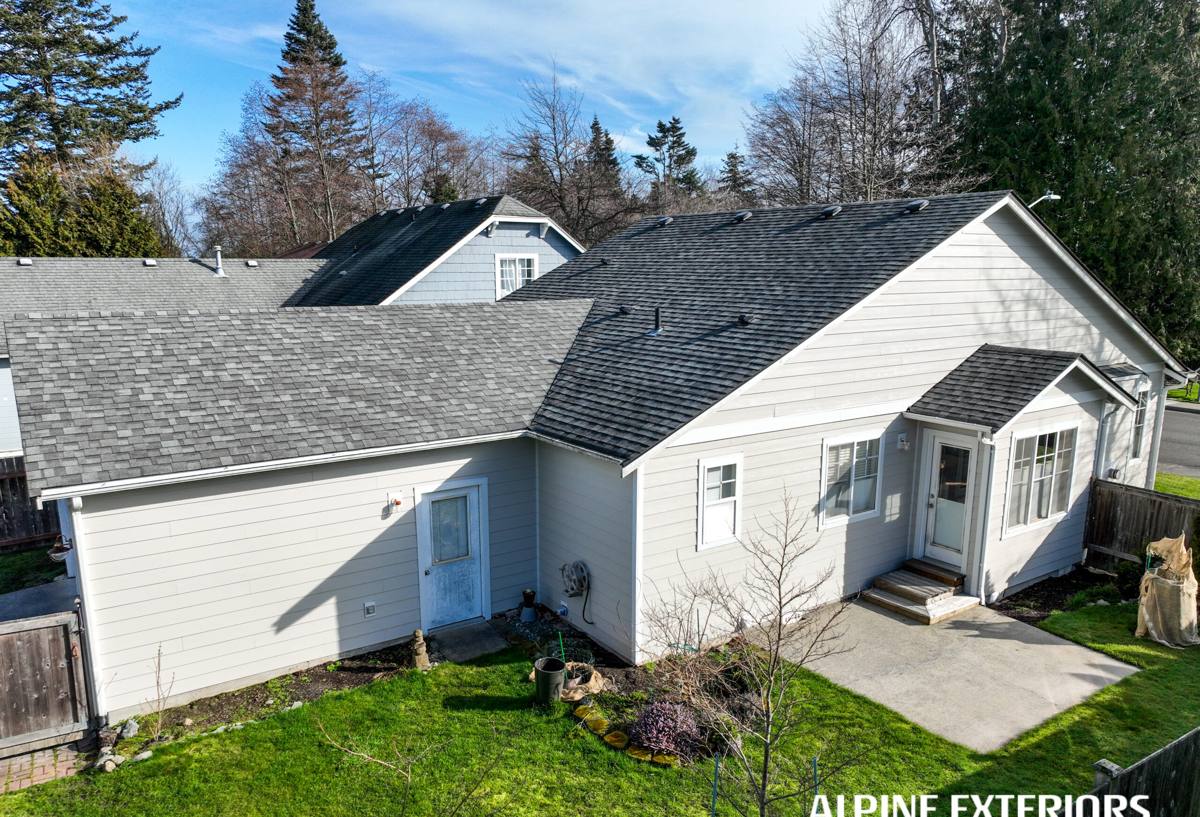
What We Typically Find on Issaquah Homes
Heavy Shade and Trapped Moisture
A lot of Issaquah lots back up to greenbelt, wooded ravines, or mature landscaping that was planted decades ago and never thinned. That's part of the appeal of living here, but it also means large sections of a home's exterior may get direct sun for only a few hours a day, if that. Siding on those elevations dries slowly, which is exactly the condition moss, mildew, and rot-prone materials need to establish themselves.
Aging Cedar, Vinyl, and LP Stock
Issaquah has a real mix of housing ages — older homes near the historic core, mid-century and 1980s-90s subdivisions, and newer construction pushing up toward the foothills. On the older end we still see a lot of original cedar and early-generation engineered wood siding that's now past its practical service life. On newer builds, vinyl and LP SmartSide are common because they were the cheaper option at construction time, not because they were the best long-term fit for this climate.
Elevation and Exposure Differences
Because Issaquah's neighborhoods range from valley floor up into the foothill slopes, exposure varies block to block. Homes higher up or more open to weather systems moving through the pass corridor can see more driving rain against walls than homes tucked into the valley. We look at each home's actual site conditions rather than assuming every job in the area is the same.
Why We Only Install James Hardie Fiber Cement
King County Siding installs one exterior siding system: James Hardie fiber cement. We don't install LP SmartSide, vinyl, Cemplank, Allura, primed spruce, or cedar. That's a deliberate standard, not a lack of options.
Every one of those alternatives has legitimate strengths — cedar's appearance, vinyl and LP's lower upfront cost — and we're not going to pretend otherwise. But in a climate like Issaquah's, where siding spends a large share of the year wet or shaded, the trade-offs stack up fast:
- Wood-based products (cedar, LP, primed spruce) rely on paint film and edge sealing to keep moisture out. Once that seal is compromised — a nail pop, a scuff, an unsealed cut edge — water gets into the substrate, and in a shaded, high-moisture environment it doesn't dry back out quickly.
- Vinyl doesn't rot, but it expands and contracts with temperature swings, can crack in impacts, and its color is baked into thin plastic that fades and chalks over the years. It also doesn't offer real fire resistance.
- Other fiber cement brands (Cemplank, Allura) are chemically similar to Hardie but don't carry the same regional-engineered product lines, factory finish warranty structure, or track record we've built our installation process around.
Fiber cement, done right, doesn't have that moisture-through-the-substrate failure mode. It's non-combustible, it holds paint and factory finish far longer than wood, and it's engineered specifically for climates like ours. That's why it's the only product we put our name behind.
The James Hardie Lines We Use
James Hardie builds siding for specific climate zones, and the Pacific Northwest falls under their HZ5 engineered formulation — designed around exactly the freeze-thaw cycles, sustained moisture, and moss/mildew pressure that Issaquah homes deal with. On top of that, most homeowners choose ColorPlus factory-applied finish, which is baked on in a controlled facility rather than field-painted, giving significantly better fade and chip resistance than a job-site paint job.
| Product Line | Best For | Notes |
|---|---|---|
| HardiePlank Lap Siding | Most Issaquah homes, traditional and modern styles | Widest color and texture selection, the standard workhorse product |
| HardiePanel Vertical Siding | Modern builds, accent gables, board-and-batten looks | Common on newer foothill-area construction |
| HardieShingle | Craftsman and cottage-style homes | Staggered or straight-edge shingle profiles |
| HardieTrim | Corners, window and door trim, fascia | Matched fiber cement trim resists the same shade and moisture pressure as the field siding |
What Correct Installation Looks Like in This Climate
Fiber cement performs the way it's supposed to only when it's installed to spec. In a wet, shaded environment like Issaquah, a few details matter more than they would in a drier climate:
Flashing and Water Management
Every window, door, and penetration needs proper flashing and house wrap integration behind the siding, not just caulk at the surface. Caulk fails; flashing and correct laps don't, as long as they're installed right the first time.
Clearances That Let Things Dry
Hardie's own installation guidelines call for minimum clearances from grade, roof lines, and decks. On heavily landscaped or wooded lots — common around here — we also pay attention to keeping plantings pulled back so air can actually move across the siding face and it gets a chance to dry between rain events.
Fastening and Joints
Improper fastener placement or gaps at butt joints are the two most common installation mistakes we see when we're called in to fix someone else's work. Both create entry points for water that fiber cement itself would otherwise resist.
Roofing, Windows, and Decks Face the Same Pressure
Siding rarely fails in isolation. On most Issaquah homes we look at, roofing, window flashing, and deck framing are dealing with the same driving rain and moss exposure as the siding, and problems in one area tend to show up as damage in another — a leaking window head flashing that's been feeding moisture into the wall assembly, or a mossy roof valley shedding organic debris straight onto a siding run below it. Because we handle siding, roofing, windows, and decks, we can evaluate the whole exterior envelope on one visit instead of treating each component as a separate problem.
What Drives the Cost of a Siding Project
Every home is different, but these are the factors that actually move the number on an Issaquah project:
| Factor | Why It Matters |
|---|---|
| Home size and stories | More square footage and taller walls mean more material and more staging/lift access |
| Tear-off vs. new construction | Removing failing cedar, vinyl, or LP and repairing sheathing underneath adds labor |
| Trim and architectural detail | Craftsman-style trim, multiple gables, and dormers take more time than flat wall runs |
| Product line and finish | Shingle profiles and vertical panel accents cost more than standard lap siding |
| Site access | Sloped foothill lots and mature landscaping can add setup and staging time |
Simple Upkeep for Hardie Siding in Issaquah
One of the practical advantages of fiber cement over wood or vinyl in this climate is how little it actually needs. A short annual routine covers most of it:
- Rinse siding down once a year, focusing on shaded north- and east-facing walls where moss and algae get the most encouragement
- Keep gutters clear so overflow isn't running down the wall face during heavy rain
- Trim back shrubs and tree limbs that are holding moisture against the siding or blocking airflow
- Walk the exterior after major storms and check caulking at trim joints and penetrations
- Note any impact damage or hairline cracks early — fiber cement is easy to spot-repair before a small issue becomes a bigger one
Why a Local Crew Matters Here
Issaquah's mix of older in-town homes, established subdivisions, and newer foothill construction means every job comes with its own site conditions, permitting requirements, and weather windows. A crew that works across King County regularly knows how to sequence a project around the region's rain patterns, how local building department expectations run, and what actually holds up on homes with heavy tree cover — not just what looks good on paper. We show up knowing this area, not learning it on your project.
If you're dealing with aging siding, want to compare what a Hardie exterior would look like on your home, or just want an honest read on your roof, windows, or deck while we're there, we're glad to take a look. Reach out for a free, no-pressure estimate using the form below.