 King County
 Seattle's Climate Is Harder on Siding Than It Looks
Seattle doesn't get hurricanes or hailstorms, and that fools a lot of homeowners into thinking the exterior of their house has an easy job. It doesn't. What Seattle delivers instead is relentless, low-intensity moisture exposure: eight or nine months a year of drizzle, fog, and driving rain off Puget Sound, punctuated by short dry spells that never fully dry the wood, trim, or siding underneath. Add salt-laden air moving in off the Sound and Elliott Bay, shaded lots under mature evergreens that never get a full afternoon of sun, and a moss and algae season that can run nearly year-round, and you have a climate that is quietly brutal on the wrong siding material.
Homes in King County don't fail dramatically. They fail slowly — a soft spot behind a downspout, a bulge where paint has been trapping moisture for a decade, a corner board that's been wicking water since a builder skipped the flashing detail. By the time it's visible, the damage has usually been building for years. The material you choose, and how it's installed, determines whether that slow damage happens at all.
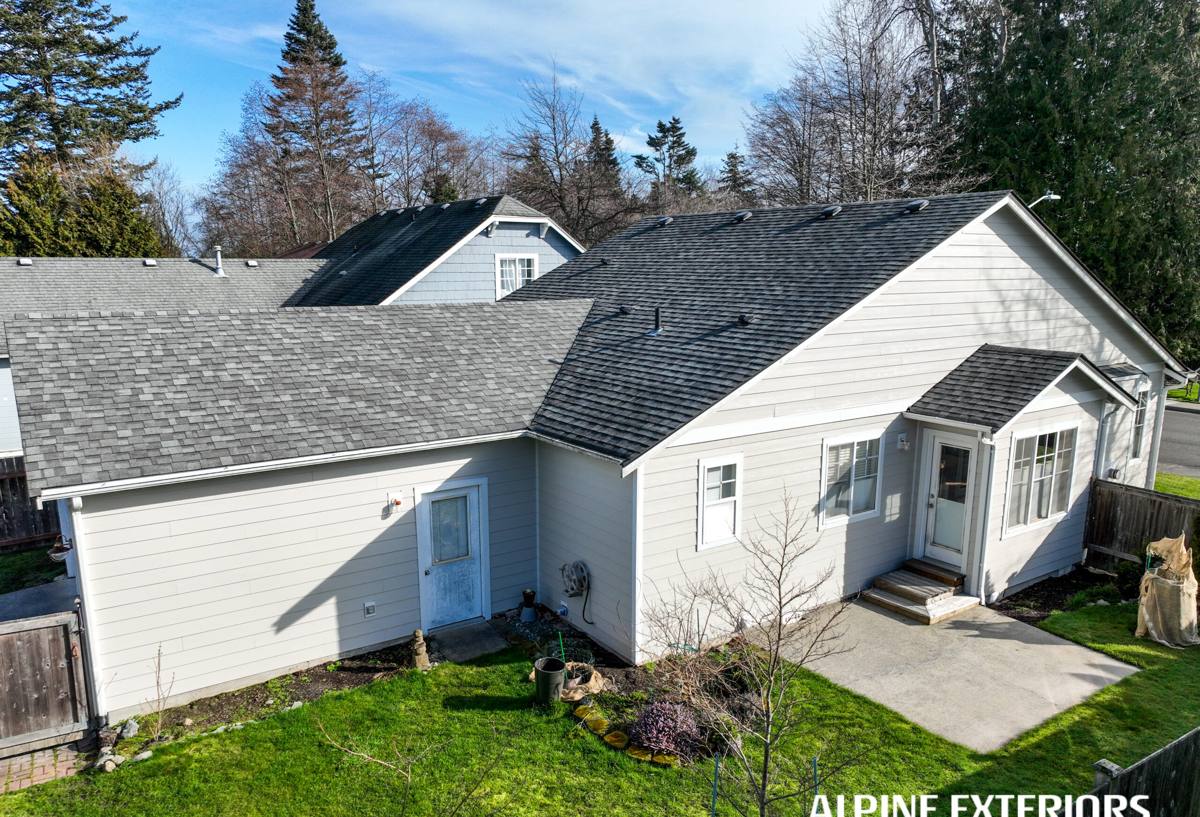
What Driving Rain and Salt Air Do to Siding Over Time
Moisture That Never Fully Leaves
Wood-based siding products — cedar, primed spruce, and engineered wood products like LP SmartSide — rely on paint and caulking to keep water out. In a climate that gets brief sun breaks between rain systems, that paint film rarely gets the sustained dry time it needs to stay fully sealed. Hairline cracks open at seams and fastener heads, water gets behind the material, and because it's wood at the core, it swells, checks, and eventually rots from the inside out — often invisibly until the siding is soft to the touch.
Salt Air's Slow Corrosion
Closer to the Sound, salt-laden air accelerates corrosion on fasteners, flashing, and any exposed metal trim. It also breaks down certain paint and coating chemistries faster than an inland climate would. Materials and finishes that aren't formulated to handle that combination age faster than their warranty paperwork suggests.
Moss, Algae, and Shade
King County's tree canopy is one of its best features and one of its toughest conditions for an exterior. Shaded north and west walls stay damp far longer after a storm, which is exactly what moss and algae need to take hold. On porous or wood-based siding, that growth holds moisture against the surface and accelerates decay. On a properly finished fiber cement product, it's a surface issue that rinses off without threatening the material underneath.
Why We Only Install James Hardie Fiber Cement
We made a deliberate decision as a company to install James Hardie fiber cement siding exclusively — not vinyl, not LP SmartSide, not cedar, not lower-cost fiber cement alternatives like Cemplank or Allura. That's not a marketing position; it's a standard we hold because of what we've seen hold up in this specific climate over years, not just on a spec sheet.
What Fiber Cement Solves
- It's non-combustible, which matters given King County's growing wildfire-smoke and ember exposure in dry late-summer stretches, even in a generally wet climate.
- It doesn't rot, because there's no wood fiber for moisture to break down.
- It holds paint and factory finishes far longer than wood substrates because it doesn't expand and contract with moisture the way wood does.
- James Hardie's ColorPlus finish is baked on at the factory under controlled conditions, which produces a more consistent, longer-lasting color than field-applied paint ever will in a climate this wet.
- It's engineered in regional formulations — Hardie's HZ10 product line is built for climates like ours, balancing moisture and temperature performance for the Pacific Northwest specifically.
We're not going to tell you every other product is worthless — vinyl and engineered wood both have real uses and real advantages elsewhere. But for the way King County weather behaves, we don't think they hold up as well over a 20-plus year horizon, and we're not willing to put our name on an install we don't believe in.
Vinyl and Engineered Wood: The Honest Trade-Offs
Vinyl Siding
Vinyl is inexpensive and low-maintenance in the sense that it doesn't need repainting. But it's a thin plastic product that expands and contracts significantly with temperature swings, which opens gaps at seams over time — gaps that let wind-driven rain track behind the panels in exactly the weather pattern Seattle produces most of the year. It also can't be painted a different color later without voiding warranties on most products, and it doesn't offer the same fire performance as fiber cement.
LP SmartSide and Engineered Wood
Engineered wood siding has improved a lot over the decades, and it can perform reasonably well in drier climates with disciplined maintenance. In King County's wet season, though, it's still a wood-strand product at its core, which means any breach in the factory coating — a nail pop, a poorly sealed cut edge, a gap at a window trim — gives moisture a path into material that can swell and deteriorate. We've refused to install it not because it's a bad product everywhere, but because we don't think it's the right fit for how wet this specific region stays for so much of the year.
Comparing Siding Materials for a King County Home
| Material | Moisture Resistance in Wet Climates | Maintenance | Fire Performance | Typical Lifespan |
|---|---|---|---|---|
| James Hardie Fiber Cement | Excellent — non-organic core, engineered HZ formulation for the region | Low — factory finish holds color for years | Non-combustible | 30+ years, often longer with maintenance |
| Vinyl | Fair — seams can allow water intrusion over time | Low, but limited repair/color options | Combustible, can deform in heat | 20-30 years |
| LP SmartSide / Engineered Wood | Fair to good if maintained diligently | Moderate — coating breaches need prompt repair | Combustible | 20-30 years with upkeep |
| Cedar | Poor to fair without rigorous upkeep | High — regular refinishing required | Combustible | Varies widely by maintenance |
What Correct Installation Looks Like Here
Fiber cement's long-term performance depends almost entirely on installation quality — this is where a lot of houses actually run into trouble, regardless of what siding is on them. In a climate that sees as much sustained moisture as King County, a few details matter more than usual:
Drainage Plane and Rainscreen Gap
A proper water-resistive barrier behind the siding, combined with a rainscreen gap that lets any incidental moisture drain and the wall assembly breathe, is what keeps trapped moisture from ever becoming a problem in the first place. This is arguably the single most important detail for a wet-climate installation.
Flashing and Sealant at Every Penetration
Windows, doors, hose bibs, light fixtures, and vents all penetrate the siding plane. Each one needs proper flashing and sealant detail, not just caulk smeared over a gap. Skipped flashing is one of the most common causes of hidden water damage we see on homes we're asked to re-side.
Fastening and Clearances
James Hardie specifies fastener types, spacing, and minimum clearances from grade, decks, and roof lines for a reason — those clearances keep splash-back and standing water away from the bottom edge of the siding, which is the most exposed part of any installation.
Roofing, Windows, and Decks: Why the Whole Envelope Matters
Siding doesn't work in isolation. We handle roofing, windows, and decks alongside siding because a wet-climate home is one connected system — a roof that's shedding water improperly, a window that isn't flashed correctly, or a deck ledger that's trapping moisture against the wall can undermine even a perfect siding installation. When we look at a King County home, we're looking at how water moves across the whole exterior, not just at the siding panels themselves.
Signs Your Current Siding Needs Attention
- Soft spots, especially near the bottom courses, around downspouts, or below window sills
- Persistent moss or algae growth that returns quickly after cleaning, especially on shaded walls
- Bubbling, peeling, or chalking paint that keeps recurring in the same spots
- Visible gaps or separation at seams, corners, or trim boards
- A musty smell in an adjacent interior room, which can indicate moisture behind the wall
What a Local Crew Actually Changes
A lot of siding problems in this region trace back to installation crews applying details that work fine in a dry climate but don't account for how long King County walls stay damp. A crew that works this area regularly knows which walls take the worst weather exposure, where moss pressure runs highest, and how much clearance and drainage detail is actually needed here versus what a generic install guide might assume. That local pattern recognition is part of what separates an installation that lasts three decades from one that starts showing problems in eight or nine years.
Planning a Siding Project in Seattle
Whether you're dealing with failing wood siding, aging vinyl, or you're simply ready to move to a material built for this climate, the process starts with an honest look at your home's exterior — where water has been getting in, where the existing assembly is holding up, and what a correct James Hardie installation would involve for your specific house. We're happy to walk through that with you, explain what we find, and give you a straightforward estimate with no pressure to decide on the spot.