 King County
 Seattle's Climate Is Hard on Siding — Here's What That Means for Your Home
Seattle sits in a climate that punishes cheap or poorly installed siding faster than most parts of the country. You've got near-constant fall and winter rain, long stretches of gray, damp weather that never really dries out, salt-laden air moving in off Puget Sound, and a moss and algae season that can run for months on shaded or north-facing walls. None of that is exotic weather — it's just persistent. And persistence is exactly what wears down siding that wasn't built or installed for it.
The siding on a Seattle home isn't fighting one big storm a year. It's fighting thousands of hours of moisture exposure, freeze-thaw cycling in the colder months, and a steady film of organic growth that holds water against the wall longer than it should sit there. Products and installation details that would be fine in a drier climate start showing problems here within a few years — swelling at seams, soft spots at the bottom courses, paint that won't hold, and moss creeping up from the ground line.
That's the backdrop for every siding decision we make on a King County home, and it's why we install James Hardie fiber cement exclusively. It's not a marketing position — it's a response to what actually holds up here.
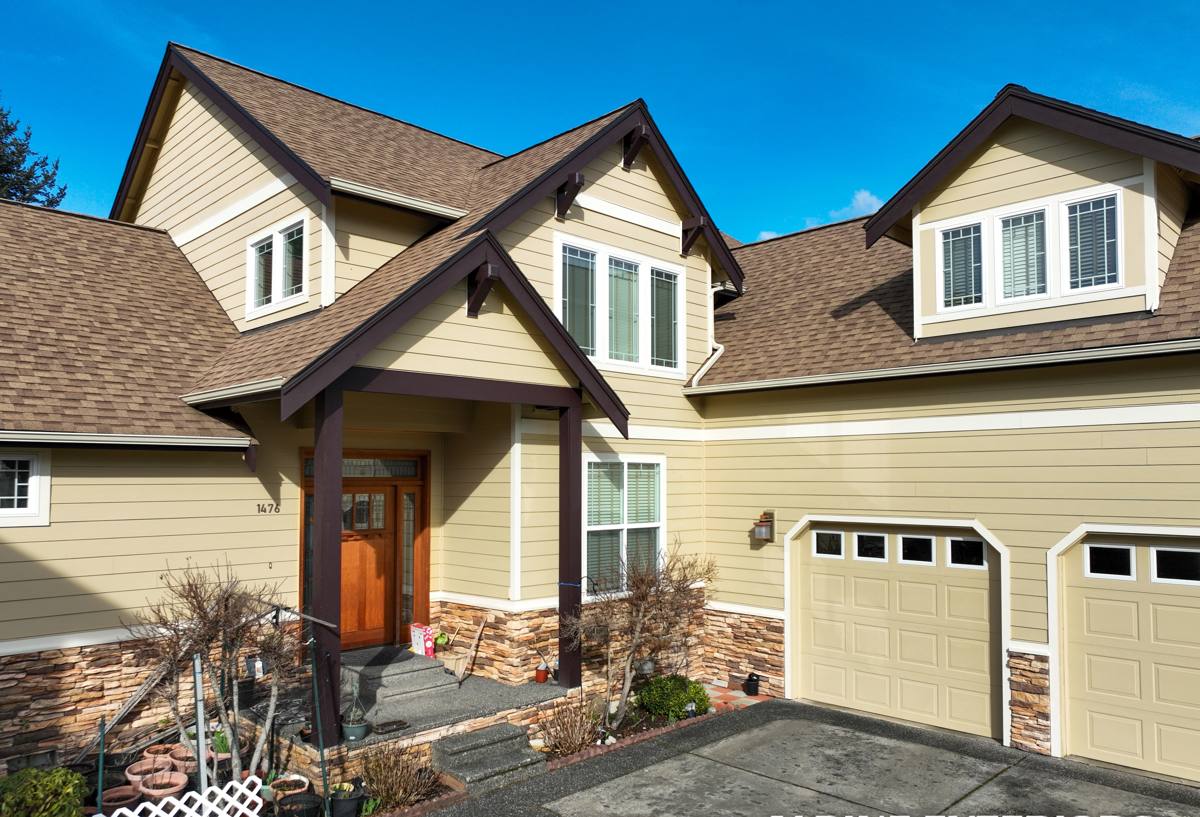
Why James Hardie Is the Right Fit for This Specific Climate
James Hardie siding is fiber cement — a mix of cement, sand, and cellulose fiber engineered to resist moisture, fire, and pests in a way wood-based and vinyl products can't match. For Seattle specifically, a few things matter more than the marketing brochure:
- It doesn't absorb and swell. Fiber cement doesn't take on water the way wood-based products do, so it doesn't warp, delaminate, or swell at the seams during our wet months.
- It resists moss and algae staining better than it prevents growth. No siding is immune to organic growth in this climate, but Hardie's factory finish holds up to cleaning far better than a field-painted or unfinished surface, so you can actually get the moss off without stripping the finish.
- It's non-combustible. Not a primary concern for coastal King County the way it is east of the mountains, but it's one more reason the product performs well long-term with no compromise.
- The factory finish (ColorPlus) is baked on, not brushed on. That matters enormously in a climate where field-applied paint has a short window each year to cure properly before the rain comes back.
We'll get into the trade-offs of alternative products below, but the short version is this: in a climate defined by sustained moisture and organic growth, the product's core material and finish matter more here than almost anywhere else in the country.
What "Correct" Installation Looks Like Here
James Hardie siding is only as good as the installation behind it. In a dry climate, installation mistakes might take a decade to show up. In Seattle, they show up in two or three wet seasons. A correct install for this area includes:
Weather-Resistive Barrier and Drainage Plane
Every wall gets a proper weather-resistive barrier, and on most homes we install furring strips or a purpose-built rainscreen product behind the siding. This creates a drainage gap so any moisture that gets past the siding — from wind-driven rain, condensation, or a failed seal — has somewhere to go instead of sitting against the wall sheathing. This detail alone is one of the biggest differences between siding that lasts 30+ years in Seattle and siding that starts failing at year eight.
Flashing at Every Penetration
Windows, doors, hose bibs, light fixtures, deck ledgers — every point where something interrupts the siding plane needs proper flashing and integration with the water-resistive barrier. Given how much rain this area gets, a missed or shortcut flashing detail isn't a hypothetical problem — it's a guaranteed leak path within a few wet seasons.
Correct Fastening and Clearances
James Hardie publishes specific fastener types, spacing, and minimum clearances from grade, roof lines, and other siding terminations. Bottom-of-wall clearance from soil, decks, and paved surfaces matters a lot here, since splashback and standing moisture at the base of a wall is one of the most common failure points we see on older siding jobs.
Caulking and Joint Treatment
Seams and butt joints need to be treated correctly — sometimes caulked per Hardie spec, sometimes left as a designed reveal, depending on the product line and detail. Over-caulking or under-caulking both cause problems in a climate this wet.
Product Lines That Make Sense for Seattle Homes
James Hardie makes several siding profiles and, more importantly, engineers products for specific climate zones under its "HZ5" designation for the Pacific Northwest's wetter, more moderate climate. The right choice depends on the home's style and your priorities:
| Product Line | Best For | Notes for Seattle |
|---|---|---|
| HardiePlank Lap Siding | Most home styles, classic horizontal lines | The most common choice locally; available in smooth or cedar-textured finish |
| HardiePanel Vertical Siding | Modern builds, accent walls, gable ends | Clean vertical lines; pairs well with board-and-batten detailing |
| HardieShingle | Craftsman and cottage-style homes | Mimics a shingled look without the moisture issues of real wood shingles |
| HardieTrim | Corners, window and door surrounds, fascia | Matched finish system so trim and siding age together |
All of these are available in ColorPlus factory finishes, which matters a great deal in a climate where field painting has a narrow dry window and doesn't hold up to years of damp exposure as well as a baked-on finish.
What We Don't Install, and Why It Matters Here
We install James Hardie fiber cement only — not vinyl, not LP SmartSide or other engineered wood siding, not cedar or primed spruce, not off-brand fiber cement like Cemplank or Allura. That's a deliberate standard, and in a climate like Seattle's, the reasoning holds up:
- Vinyl expands and contracts with temperature swings, and its seams and J-channels give moisture a path inward over time. It also doesn't offer the same impact resistance or color depth as a factory-finished fiber cement product.
- Engineered wood siding performs fine in drier climates but relies heavily on field sealing at every cut edge and seam staying intact for its full life. In a climate with this much sustained moisture, any gap in that maintenance is where trouble starts.
- Cedar and primed spruce are real wood — beautiful, but they need ongoing refinishing and are more vulnerable to moisture, rot, and pest damage than fiber cement, especially in shaded, damp areas that don't dry out quickly.
- Off-brand fiber cement may be a similar material, but we don't have the same confidence in the finish systems, climate engineering, or warranty support that James Hardie backs its products with, so we don't install it.
None of these are bad products in the abstract — they just come with maintenance and moisture trade-offs that we don't think make sense to put on a customer's home in this climate. We'd rather install one product very well than several products with varying levels of long-term risk.
Our Process for a Seattle Siding Job
- On-site assessment. We walk the home, check the current siding and sheathing condition, look for existing moisture damage, and note problem areas like low clearances, missing flashing, or heavy shade/moss zones.
- Written estimate and product selection. We'll walk you through which Hardie profile and finish fits your home and budget, with a clear, itemized scope.
- Tear-off and sheathing check. Old siding comes off and we inspect the sheathing underneath for rot or damage before anything new goes up — this is where hidden problems from a prior install often surface.
- Weather barrier and rainscreen installation. This is the step that protects the wall assembly for the life of the siding, and it's not one we shortcut.
- Flashing and trim. All penetrations, window and door surrounds, and terminations get flashed and detailed to spec before siding goes up around them.
- Siding installation. Installed to James Hardie's published fastening, spacing, and clearance requirements for our climate zone.
- Final walkthrough. We review the finished job with you, confirm caulking and touch-up work is complete, and go over basic care.
Living With Hardie Siding in a Wet, Mossy Climate
Even the right product needs a little homeowner attention in this climate. A short annual routine goes a long way:
- Rinse siding once or twice a year with a garden hose to keep moss spores and organic buildup from taking hold, especially on shaded north- or west-facing walls.
- Keep gutters clear so overflow isn't running down the siding face during heavy rain events.
- Trim back landscaping and tree cover that keeps a wall section shaded and damp longer than the rest of the house.
- Check caulking at trim and penetrations every couple of years and have gaps resealed before they become a moisture path.
- Avoid pressure washing directly at siding seams — a soft wash is enough and won't force water behind the panels.
None of this is heavy maintenance compared to repainting wood siding every few years — it's the reason fiber cement with a factory finish makes sense for a climate that doesn't give paint much of a chance to cure and hold.
Why Hire a Crew That Already Works in Seattle
Installation quality is what determines whether James Hardie siding performs the way it's engineered to over 30-plus years, or starts causing problems in year five. A crew that regularly works King County homes already understands the region's rain patterns, moss pressure, and the specific flashing and clearance details that matter here — it's not generic siding knowledge, it's local pattern recognition built from doing the work in this exact climate. We stand behind our installation, and we only put our name on a product we trust to hold up to what Seattle throws at it year after year.
If you're planning a siding replacement and want a straightforward, honest look at what your home needs, we're happy to come take a look. Reach out for a free, no-pressure estimate using the form below.