 King County
 Sammamish's Climate Is Harder on Siding Than It Looks
Sammamish doesn't get the dramatic weather of other parts of the country, and that's exactly why siding problems here tend to sneak up on homeowners. There's no hurricane, no hailstorm, no obvious event that triggers a call to a contractor. Instead, it's the slow accumulation of a wet climate working on exterior materials year after year: eight-plus months of intermittent rain, heavy tree canopy that keeps north- and west-facing walls shaded and damp long after a storm passes, and humidity that rarely lets siding fully dry out between rain events.
Add in the broader marine climate that moves through the Puget Sound region and settles over the rest of King County, and you get a mix of driving rain, persistent moisture, and a moss and algae season that can run from fall through spring on the shadier sides of a house. Wood-based sidings absorb that moisture. Improperly sealed seams wick it. Vinyl doesn't rot, but it flexes, fades, and gaps in ways that let water find a path behind it. Over a decade or two, that steady moisture exposure is what actually determines how a house's exterior ages — not any single storm.
Sammamish's wooded lots and lake-adjacent microclimate make this more pronounced than in more open, paved parts of King County. Homes tucked into tree cover stay damp longer after rain. Homes near Lake Sammamish deal with higher ambient humidity. Either way, the siding on a Sammamish house is working harder, more often, than most homeowners realize.
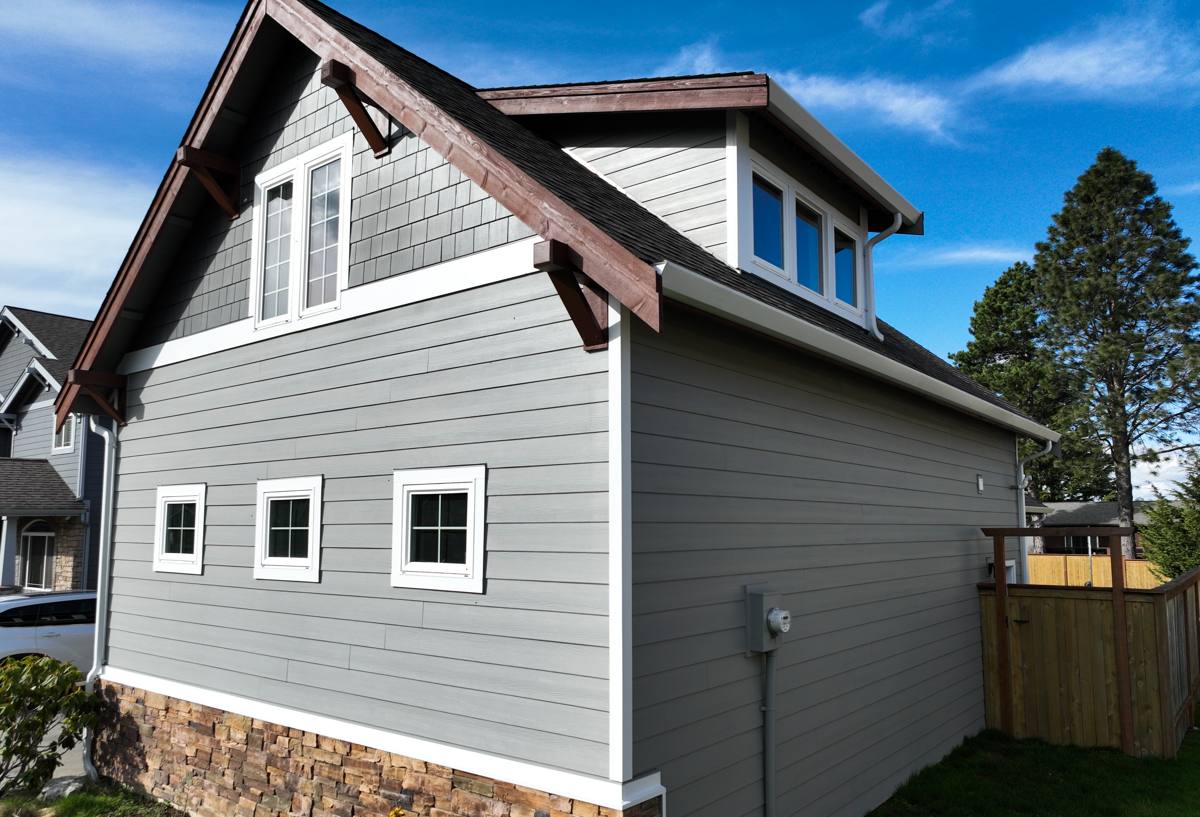
Why We Only Install James Hardie Fiber Cement
King County Siding installs one siding system: James Hardie fiber cement. We don't install LP SmartSide, vinyl, Cemplank, Allura, primed spruce, or cedar. That's not a marketing position — it's a standard we hold because of what we've seen these products do, and not do, over years of real Pacific Northwest weather exposure.
What the alternatives actually involve
Wood siding (cedar, primed spruce) looks great on day one and can look great for years if maintained relentlessly — but "relentlessly" is the operative word in a climate like Sammamish's. Repainting, caulking, and moisture monitoring become a recurring cost and a recurring risk. Miss a cycle and rot can set in behind the finish before it's visible from the ground.
Vinyl siding is low-maintenance and inexpensive, but it's a thin, flexible plastic product. It expands and contracts with temperature swings, can crack in cold snaps, fades under UV exposure, and — critically for this region — relies on gapped, overlapping panels that aren't designed to be a true water barrier. In a climate with this much sustained rainfall, that matters more than in drier regions.
LP SmartSide, Cemplank, and Allura are all reasonable engineered products, and we don't claim they're defective. But we've standardized on one system so we can guarantee installation quality, warranty backing, and long-term performance without hedging across product lines. James Hardie is that system for us.
What Hardie gets right for this climate
| Factor | James Hardie Fiber Cement | Wood / Vinyl / Engineered Wood |
|---|---|---|
| Moisture response | Won't rot; engineered for wet climates (HZ10 configuration) | Wood absorbs and can rot; vinyl gaps let water pass behind panels |
| Combustibility | Non-combustible fiber cement | Wood and engineered wood are combustible; vinyl can melt/deform |
| Finish | Factory-applied ColorPlus finish, baked on | Field-applied paint (wood) or molded-in color that fades (vinyl) |
| Maintenance | Periodic caulk/inspection; no repainting cycle needed | Wood needs repainting every few years; vinyl needs periodic cleaning |
| Warranty | Long-term, transferable manufacturer warranty | Varies widely; often shorter or non-transferable |
Signs a Sammamish Home Needs New Siding
Because siding failure here is gradual, most homeowners find out something is wrong when it's already worked its way through the surface. Some of the earlier warning signs to watch for:
- Persistent green or black staining on shaded walls that returns quickly after cleaning
- Soft spots, bubbling, or visible warping, especially near ground level or under gutters
- Paint that's peeling or bubbling rather than just fading
- Visible gaps at panel seams, corners, or trim that weren't there when the house was newer
- Rising energy bills without another clear cause — a sign the wall assembly may no longer be sealing properly
- Musty smells near exterior walls inside the home
- Nail heads or fastener patterns showing through the surface
Any one of these on its own isn't necessarily an emergency. Several together, or any sign paired with visible moss buildup that won't stay clean, is worth a professional look before it becomes a rot repair instead of a siding upgrade.
How We Install Hardie Siding for Sammamish Conditions
Product selection for the climate
James Hardie engineers its products by climate zone (HZ5 and HZ10 configurations), and the Pacific Northwest falls into the wetter category. That means the specific formulation and installation guidance for this region is built around sustained moisture exposure — not a generic national spec. We install to that regional configuration, not a one-size-fits-all approach.
What correct installation actually involves
Fiber cement performs the way it's supposed to only when it's installed to spec, and Hardie is more installation-sensitive than people assume. That means:
- Proper weather-resistive barrier and rainscreen or drainage plane behind the siding, so any incidental moisture has somewhere to go
- Correct fastener type, spacing, and placement — under- or over-driven nails are one of the most common failure points on fiber cement jobs done wrong
- Flashing and kick-out details at every roofline, window, and door intersection, which is where the vast majority of real water intrusion problems originate, regardless of siding material
- Manufacturer-specified clearances from grade, decks, and roof lines, to keep the bottom edge of the siding out of standing moisture and splash-back
- Caulking and sealant at joints using compatible, long-life products — not whatever's on the truck
We've seen fiber cement jobs fail prematurely, and it's almost never the product's fault — it's a flashing detail skipped, a fastener schedule ignored, or clearances not respected. That's the case for hiring a crew that treats Hardie as a system, not just a material.
Roofing, Windows, and Decks: The Full Exterior Envelope
Siding doesn't work in isolation. On a Sammamish home under tree cover, the roof, siding, windows, and any attached decking all interact to keep water out — or let it in. We handle roofing, window replacement, and deck construction alongside siding because a new siding job installed against a failing roof edge, a leaking window flashing, or a deck ledger that's trapping moisture against the wall will inherit that problem no matter how well the siding itself is installed.
This matters more in a wet, wooded area than in drier climates, because there's less margin for a small gap to dry out before the next rain arrives. When we scope a siding project, we look at the whole envelope — roof edges, window openings, deck attachment points — and flag anything that needs attention before or during the siding work, rather than sealing a new product over an existing problem.
Color and Style Choices That Hold Up
James Hardie's ColorPlus finish is a factory-baked finish, not a field-applied paint job, which means it holds color and resists the fading and chalking that field-painted wood siding shows within a few years in this climate. For Sammamish homes — many set against heavy greenery and tree cover — that consistency matters, since natural light is filtered and muted for a good part of the year, and a siding color that shifts unevenly stands out more against that backdrop, not less.
Hardie's product lines give real design flexibility: horizontal lap siding for a traditional look, vertical panel siding for a more modern profile, and shingle-style siding for homes going for a craftsman or cottage feel. Trim, soffit, and fascia products are available to match, so the whole exterior reads as one designed system rather than mismatched materials.
Cost factors on a Sammamish siding project
| Factor | Why It Moves the Price |
|---|---|
| Home size and wall complexity | More corners, gables, and dormers mean more cutting, flashing, and labor time |
| Current siding removal | Tear-off and disposal of existing material adds cost versus a bare or already-stripped wall |
| Underlying damage | Rot repair, sheathing replacement, or moisture-damaged framing found during tear-off |
| Product line and profile | Lap, panel, and shingle-style Hardie products carry different material costs |
| Access and lot conditions | Tree cover, slopes, and tight lot access common in Sammamish can add labor time |
| Trim, soffit, and fascia scope | Replacing the full exterior system versus siding alone changes total scope |
Why a Local Crew Matters Here
King County Siding works throughout King County, and that regional focus is deliberate. A crew that installs siding across a range of Puget Sound microclimates — from lake-adjacent, tree-heavy communities like Sammamish to more exposed areas elsewhere in the county — develops a feel for how water actually moves on a real house in this weather, not just what a spec sheet says. That shows up in the small decisions: where to add extra flashing even though code doesn't strictly require it, which corners of a shaded lot need a closer look, and how to sequence a job around this region's rain patterns instead of fighting them.
It also means straightforward accountability. If a warranty question or a callback comes up years later, you're dealing with the same local company that did the original work, not a national franchise or a crew that moved on to another state.
What to Expect From a Sammamish Siding Project
A typical project starts with an on-site assessment — looking at the existing siding, checking for any moisture or rot behind it where accessible, and reviewing flashing at rooflines, windows, and decks. From there, we put together a scope and a written estimate before any work begins. Once a project is scheduled, timelines depend on home size and scope, but most single-family siding jobs run from several days to a couple of weeks, weather permitting. Because of the regional rain pattern, dry-season scheduling (roughly late spring through early fall) is often preferred for tear-off and install, though it's not the only window that works.
Throughout the job, the goal isn't just to put new material on the wall — it's to leave the whole exterior envelope, from flashing to fasteners to finish, in a state that's built to handle another few decades of Sammamish weather.
If your siding is showing wear, or you're planning ahead for a home you want to hold onto for the long term, we're happy to take a look and give you a straightforward, no-pressure estimate — no obligation, just an honest read on where things stand.