 King County
 Why Siding Choice Matters More on the Sammamish Plateau
Sammamish sits up on a forested plateau east of Lake Washington, and that setting creates a specific set of problems for exterior siding. Heavy tree canopy means more shade, more standing moisture, and slower drying times after a storm. Add the driving rain that blows through King County for much of the year and a long moss season that coats north-facing walls and anything shaded by trees, and you have a climate that is genuinely hard on siding. Products that aren't engineered for sustained moisture exposure — or that were installed without proper drainage detailing — tend to show it here faster than they would in a drier part of the state.
We install James Hardie fiber cement siding exclusively. It's not the only siding product on the market, but after years of working on homes throughout King County, it's the one we're willing to put our name behind for a climate like this one. This page focuses specifically on what a correct James Hardie installation looks like for a Sammamish home, and why the details matter as much as the material itself.
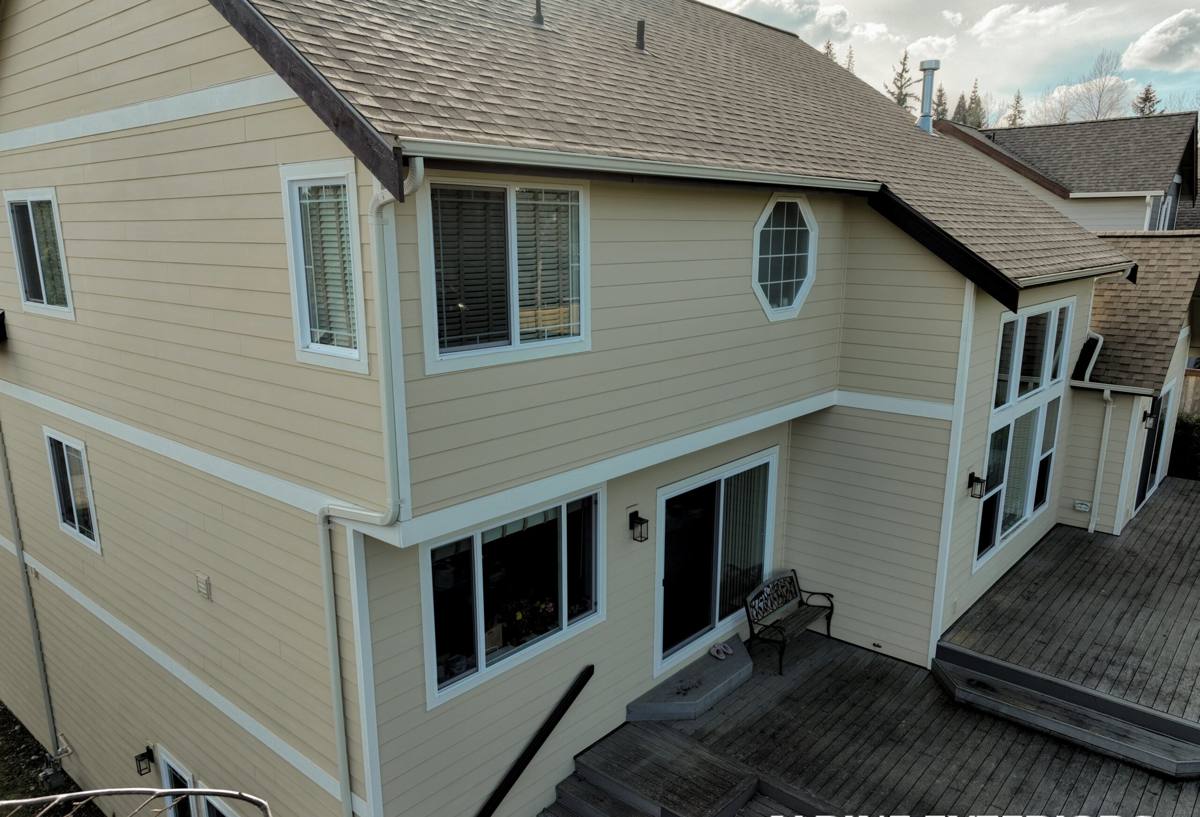
What This Climate Actually Does to a House
Moisture That Doesn't Leave Quickly
A lot of siding failure isn't about a product getting rained on — it's about what happens after the rain. On a shaded, tree-covered lot, siding can stay damp for days after a storm passes. Wood-based products and improperly sealed panel siding absorb that moisture at seams, fastener holes, and cut edges, and repeated wet-dry cycling is what eventually causes swelling, delamination, or paint failure.
Moss, Algae, and Shaded Walls
Moss doesn't just grow on roofs. On heavily shaded exterior walls — common on wooded Sammamish lots — moss and algae can take hold on any siding surface that stays damp and doesn't get much direct sun. This is mostly a cosmetic and maintenance issue, but on moisture-sensitive materials it can also trap water against the surface longer than it should sit there.
Driving Rain and Wind-Driven Water
King County storms frequently push rain sideways rather than straight down, which means water gets forced up under laps, into joints, and behind trim if those details weren't built correctly in the first place. This is why the installation matters as much as the product — a great siding material with poor flashing and drainage detailing will still fail early.
What Correct James Hardie Installation Involves
James Hardie makes a good product, but the difference between a siding job that lasts decades and one that causes problems in five years almost always comes down to installation. For a climate like Sammamish's, we pay particular attention to a few things:
Drainage and a Working Rain Screen
Water has to have somewhere to go. That means a proper weather-resistive barrier behind the siding, a drainage gap or rain screen where conditions call for it, and flashing at every horizontal surface — window heads, doors, decks, and roof-to-wall intersections — that directs water out and away from the wall assembly instead of trapping it.
Fastening to Manufacturer Spec
James Hardie publishes specific fastening patterns, nail types, and clearance requirements, and they exist for a reason. Under-driven or over-driven fasteners, wrong nail spacing, or panels hung too tight against trim can all create points where water gets in or the board can't move naturally with temperature and moisture changes.
Joint and Seam Treatment
Butt joints, corners, and penetrations (hose bibs, vents, light fixtures) are where most siding leaks actually start. We treat these with the caulking, flashing, or trim details James Hardie specifies for the product line in use — not shortcuts that look fine on installation day but open up within a couple of wet seasons.
Product Line Matched to Exposure
James Hardie's HZ5 product line is engineered for the wetter, colder climate zone that includes the Pacific Northwest, as opposed to the HZ10 line built for hot, humid regions. Using the correct climate-engineered product for King County isn't optional — it's part of what makes the manufacturer's warranty and the product's real-world performance line up.
James Hardie Product Options for a Sammamish Home
James Hardie makes several distinct product profiles, and picking the right one depends on your home's architecture and exposure. Here's how the main options compare for a plateau home dealing with shade, moisture, and moss:
| Product | Best Use | Why It Fits This Climate |
|---|---|---|
| HardiePlank Lap Siding | Traditional and craftsman-style homes, most common choice | Overlapping profile sheds driving rain well when installed with correct exposure and flashing |
| HardiePanel Vertical Siding | Modern homes, accent walls, gable ends | Fewer horizontal laps means fewer places for wind-driven rain to work its way in |
| HardieShingle | Shingle-style or Craftsman detailing | Factory-finished texture holds up to shade and moisture better than raw wood shingle |
| HardieTrim | Corners, window and door surrounds, fascia | Non-combustible, dimensionally stable trim that won't rot the way wood trim does under tree cover |
Why We Standardized on James Hardie Instead of the Alternatives
We get asked why we don't install vinyl, LP SmartSide, or cedar. Each of those products has legitimate uses and each has real trade-offs worth understanding before you choose one for a wet, shaded King County lot:
- Vinyl siding is inexpensive and low-maintenance, but it can warp in temperature swings, doesn't hold paint if you ever want to change the color, and its seams and J-channels give wind-driven rain more entry points over time.
- LP SmartSide is an engineered wood product with real strengths, but wood-based substrates are inherently more moisture-sensitive than fiber cement, which matters on a lot with slow-drying, shaded walls.
- Raw or primed cedar looks great initially but requires ongoing refinishing to resist moisture, and untreated cut edges are a common failure point in a climate this wet.
James Hardie's fiber cement composition doesn't rot, doesn't attract insects, and is non-combustible. The ColorPlus factory finish is baked on under controlled conditions rather than field-applied, which gives more consistent, longer-lasting color performance than site-painted alternatives — a real advantage when a wall spends half the year damp and shaded. That combination is why we settled on one product line rather than offering several.
What Drives the Cost of a Siding Job Like This
| Factor | Why It Affects the Price |
|---|---|
| Existing siding removal | Tear-off, disposal, and sheathing inspection add labor beyond the new install itself |
| Sheathing and moisture damage | Rot found underneath old siding has to be repaired before new siding goes on — this is common on shaded, damp walls |
| House complexity | Dormers, multiple gables, and cut-up wall lines take more time and material than simple rectangular walls |
| Product profile and trim | Vertical panel, shingle-style accents, and custom trim packages cost more than standard lap siding |
| Access and lot conditions | Steep or heavily wooded lots common on the plateau can add scaffolding, staging, or tree-protection time |
We give a written, itemized estimate before any work starts, so you know exactly what you're paying for and why — no vague lump-sum numbers.
Our Process, Start to Finish
- On-site assessment. We walk the exterior, check for existing moisture or rot damage, and note tree cover, drainage patterns, and sun exposure on each wall.
- Written estimate. You get a clear scope of work and pricing broken down by what's actually involved on your home.
- Tear-off and inspection. Old siding comes off, and we inspect the sheathing underneath before anything new goes up. This is where hidden moisture damage gets caught.
- Weather barrier and flashing. Correct house wrap, flashing, and drainage detailing go in before a single piece of siding is hung — this step is what actually keeps water out long-term.
- Hardie installation to spec. Fastening pattern, exposure, and joint treatment follow James Hardie's published requirements for the HZ5 climate zone.
- Final walkthrough. We go over the finished job with you and address anything before we consider it done.
Signs Your Current Siding Is Already Failing
A lot of siding problems are easy to miss until they've caused real damage underneath. Look for:
- Soft or spongy spots when you press on the siding, especially near the bottom courses
- Visible gaps, warping, or buckling at seams and corners
- Persistent moss or dark staining that doesn't wash off and keeps coming back
- Paint that's peeling, bubbling, or chalking heavily in patches
- Cracks around window and door trim, or trim that's pulling away from the wall
- Musty smells or visible staining on interior walls near exterior corners
Any of these are worth a professional look before they turn into sheathing or framing repairs, which cost significantly more than catching a siding problem early.
Living With It: Maintenance in a Moss-Prone Climate
James Hardie siding is genuinely low-maintenance compared to wood or vinyl, but "low-maintenance" isn't "no-maintenance" on a shaded King County lot. A periodic soft wash to keep moss and algae from building up on north-facing and tree-shaded walls goes a long way. Keep an eye on caulked joints and trim intersections over the years — caulking is the one component of the system that eventually needs refreshing, well before the siding itself shows any wear. Trimming back tree limbs that keep a wall in near-constant shade also helps the surface dry out between storms, which reduces moss growth and extends the life of any exterior finish.
Why Hiring a Crew That Already Works This Area Matters
Installation quality is the single biggest factor in how long siding lasts, and installation quality depends on understanding the conditions a home actually faces — not just following a generic spec sheet. A crew that regularly works King County's wetter, tree-covered neighborhoods already knows where driving rain typically finds weak points, how much drainage detailing a shaded wall actually needs, and what moss and moisture damage looks like before it becomes a structural problem. That local experience shows up in the small decisions made on install day, not just the finished appearance.
If you're considering new siding for a Sammamish home, we're happy to take a look and give you a straightforward, no-pressure estimate — no invented urgency, just an honest read on your home's condition and what a correct James Hardie installation would involve. Use the form below to get started.