 King County
 Why Seattle Siding Has to Work Harder Than the Brochure Suggests
Seattle sits in a spot that's tough on exterior building materials in ways that aren't always obvious until a few winters have gone by. You've got marine air rolling in off Puget Sound carrying salt that corrodes fasteners and trim over time, a rain season that stretches for months rather than weeks, and enough shade and moisture on north- and west-facing walls to grow a healthy crop of moss and algae on almost anything that holds even a little water. Add in the freeze-thaw swings we get most winters, and you've got a climate that punishes siding choices that were never engineered for it.
A lot of siding products perform fine in a lab or in a drier climate and then struggle here. Wood swells and rots where caulk lines fail. Vinyl gets brittle and can warp when trapped moisture behind it never fully dries. Cheaper fiber cement blends without a real factory finish start chalking and fading within a handful of years under our UV and moisture cycle. None of that is a mystery to anyone who's walked a Seattle neighborhood and looked closely at siding that's ten or fifteen years old.
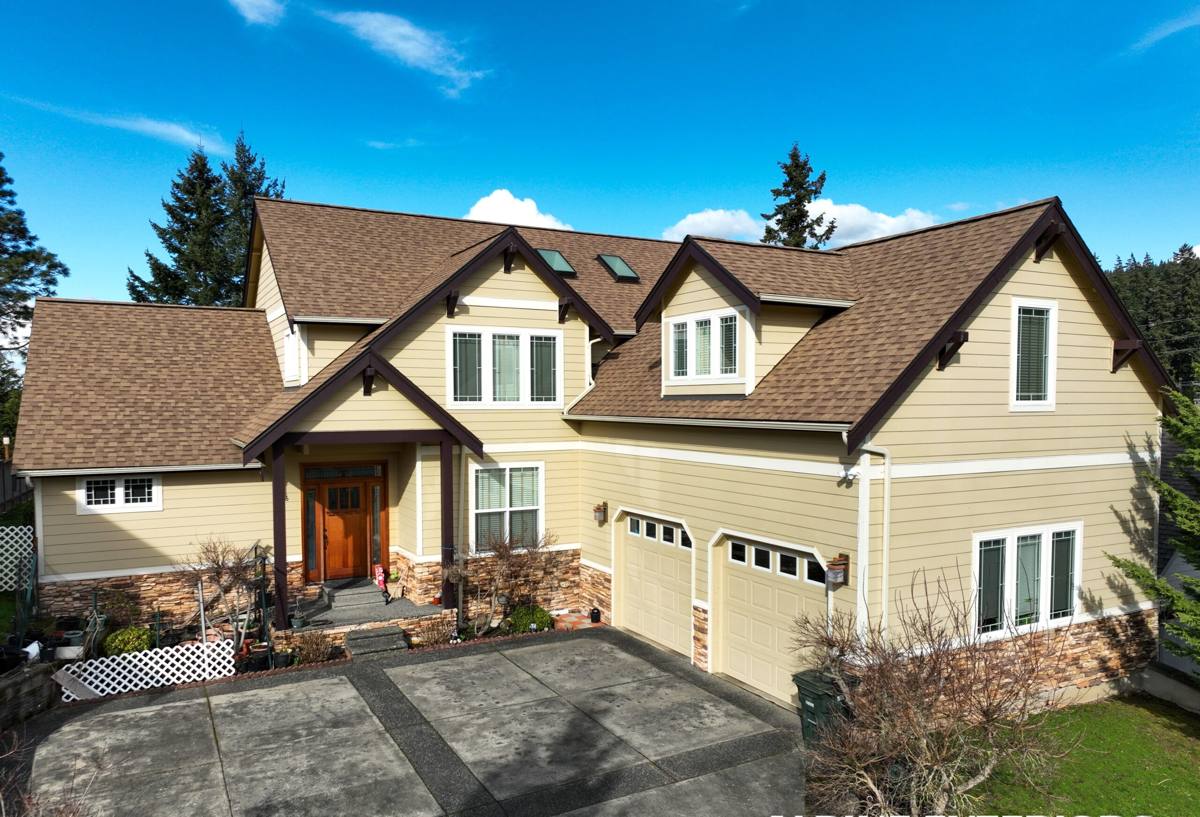
What Seattle Homes Actually Need From Their Siding
Strip away the marketing and a Seattle-area house needs a few specific things from its exterior cladding:
- Genuine resistance to sustained moisture exposure, not just "water-resistant" in the sense of shedding a light shower
- A finish that won't become a moss and algae host on shaded walls
- Fasteners and trim details that won't corrode from salt-laden air, especially in neighborhoods closer to the water
- Dimensional stability through repeated wet-dry and freeze-thaw cycles without cracking or cupping
- A factory finish that holds color without the homeowner needing to repaint every five to seven years
This is exactly the profile James Hardie fiber cement siding was engineered to meet, which is why it's the only product we install. It's not that other materials are worthless everywhere — it's that we've drawn a line on what we're willing to put our name behind on King County houses specifically.
Why We Only Install James Hardie Fiber Cement
James Hardie's fiber cement is a cement, sand, and cellulose fiber composite that doesn't rot, doesn't feed insects, and doesn't burn the way wood-based siding does. That non-combustible quality matters everywhere, but the moisture performance is what makes it the right call for the Pacific Northwest specifically. The board itself doesn't absorb water the way wood or wood-composite products do, so it doesn't swell, cup, or delaminate through our long wet season.
Just as important is the ColorPlus factory finish. Instead of field-applied paint that starts breaking down at the first sign of UV and moisture stress, ColorPlus is baked on in a controlled factory process, backed by its own finish warranty, and formulated to resist the fading and chalking that plain field-painted siding shows within a few years out here. On a house with north-facing walls that stay damp and shaded most of the year, that finish quality is the difference between siding that still looks sharp at year fifteen and siding that needs repainting by year six.
Hardie also builds region-specific product lines — its HZ5 formulation, for instance, is engineered for climates with more freeze-thaw cycling and moisture exposure than the HZ10 line built for hot, humid regions. That kind of climate-specific engineering is exactly what a house near Puget Sound benefits from, and it's a level of product-line precision that off-brand fiber cement and other siding categories simply don't offer.
What We Don't Install, and Why That's the Point
We get asked from time to time about vinyl, LP SmartSide, primed cedar, and lower-cost fiber cement alternatives like Cemplank or Allura. We're upfront about this: those aren't bad products in every application, but we've made a professional decision not to install them, because we don't want to be back at a Seattle house in eight years explaining why the siding is failing.
| Material | Where it struggles locally | Why we passed on it |
|---|---|---|
| Vinyl siding | Can warp/buckle with trapped moisture and temperature swings; thin profile shows waviness on long wall runs | Doesn't hold up to scrutiny on a house where we're staking our reputation on a 20+ year outcome |
| LP SmartSide | Engineered wood product — edges and cut ends need diligent sealing or moisture intrusion becomes a real risk in our wet season | Installation margin for error is too tight for the volume of rain King County gets |
| Primed cedar/spruce | Real wood; needs ongoing paint maintenance and is vulnerable to rot at seams and end grain | High long-term maintenance burden we don't think is fair to hand a homeowner without saying so upfront |
| Off-brand fiber cement (Cemplank, Allura, etc.) | Similar base material to Hardie but without the same factory finish system, warranty structure, or region-specific product engineering | We standardized on one manufacturer so we can guarantee installation specs and warranty backing every time |
None of this is a claim that these products are defective — it's a statement about the trade-offs, and about what we're comfortable warranting on a Seattle roofline.
What a Correct Fiber Cement Installation Actually Involves
Fiber cement siding is only as good as the install behind it, and this is where a lot of the failures we see on older Seattle homes actually originate — not from the board itself, but from shortcuts taken during installation. A correct job includes:
- Weather-resistive barrier and flashing done first. Every window, door, and penetration gets flashed and integrated with the water-resistive barrier before a single board goes up, so bulk water has a way out rather than a way in.
- Proper rainscreen gap or drainage plane. Fiber cement performs best with a small gap behind it so incidental moisture can drain and the wall can dry — critical in a climate where walls rarely get a long dry stretch to fully release moisture.
- Correct fastening. Hardie specifies fastener type, spacing, and embedment depth precisely. Over-driven or under-driven nails are one of the most common causes of premature siding failure, and it's an easy detail to get wrong if a crew isn't used to the product.
- Field-cut sealing. Any cut edge gets primed or sealed per manufacturer spec so raw cut ends aren't left exposed to moisture.
- Proper clearances. Siding needs to sit clear of grade, roofing, and decking by the manufacturer's specified minimums so splash-back and standing water don't sit against the bottom course.
- Caulking and trim details built for wind-driven rain, since our storms tend to come in sideways off the Sound rather than straight down.
Skip any one of these steps and you can end up with siding that looks fine at handoff but starts showing moisture damage, staining, or fastener corrosion within a few years — problems that get blamed on the material when the real cause was the install.
Moss, Algae, and the Long Wet Season
Seattle's moss season isn't really a season — on shaded north- and west-facing walls, conditions for moss and algae growth exist for much of the year. This is a maintenance issue as much as a product one, but the right siding makes it far more manageable. ColorPlus finish resists the surface staining that plain painted siding picks up, and its smooth factory finish doesn't give algae and moss spores the same foothold that a porous, field-painted, or textured wood surface does. Homeowners still need to do periodic gentle washing on shaded walls, but they're not fighting an uphill battle against a surface that's actively hospitable to growth.
A Simple Maintenance Routine That Actually Helps
- Rinse shaded and north-facing walls once or twice a year with a garden hose and soft-bristle brush — skip the pressure washer, which can force water behind boards or damage the finish
- Keep gutters clear so overflow doesn't run down the siding face
- Trim back shrubs and trees that keep a wall shaded and damp longer than necessary
- Check caulking at trim and penetrations every couple of years and recaulk as needed
- Address any fastener staining or popped nails early, before water has a chance to track behind the board
Salt Air and Fastener Corrosion
Homes closer to Puget Sound and Lake Washington deal with a slow, steady corrosive effect from salt-laden air on anything metal. This shows up most often as rust streaking from fasteners or corroded trim flashing long before the siding itself has any issue. Correct installation uses fastener types rated for the exposure, and we pay particular attention to this detail on homes in wind-exposed or water-facing locations across King County, where the difference between a stainless or hot-dip galvanized fastener and a standard one can mean the difference between clean walls and rust streaking within a few years.
How Our Process Works
We keep the process straightforward because most of the value is in getting the details right, not in overcomplicating the sales side:
- On-site assessment. We look at your home's actual exposure — sun, shade, wind direction, proximity to water — because that changes which details matter most on your specific walls.
- Product and color selection. We walk through Hardie's plank, shingle, and panel options and ColorPlus color range so you land on something that fits the house and the neighborhood.
- Written scope and timeline. You get a clear, itemized plan before any work starts — no vague allowances.
- Tear-off and prep. Old siding comes off, sheathing gets inspected for hidden rot or moisture damage (common on older Seattle homes), and any needed repairs happen before new material goes up.
- Weather barrier and flashing installation, done to spec, not rushed.
- Hardie installation, following manufacturer fastening, clearance, and sealing requirements exactly.
- Final walkthrough so you know what was done and what warranty coverage applies.
Why Hiring a Crew That Already Works in Seattle Matters
Fiber cement installation instructions read the same everywhere, but applying them well depends on understanding the conditions a wall actually faces. A crew that mostly works in a drier region may not think twice about drainage gaps or fastener corrosion resistance, because in their normal working environment those details matter less. A crew that works King County houses every week already knows which walls in a given neighborhood tend to stay damp longest, which orientations need extra attention to moss resistance, and which fastener specs matter most near the water. That local pattern recognition is hard to fake, and it's part of why the install quality — not just the product — determines how the siding performs a decade from now.
What This Costs, in General Terms
Fiber cement siding replacement pricing depends on the size and complexity of the home, the amount of trim and detail work, tear-off scope, and any sheathing repair that turns up once old siding comes off. Rather than quote a number that doesn't reflect your specific house, we provide a written estimate after an on-site look — that's the only way to give you a figure you can actually rely on.
If you're weighing a siding replacement on a Seattle-area home and want a straight answer about what your walls actually need, we're happy to take a look. Request a free, no-pressure estimate using the form below.