 King County
 Why Issaquah Siding Wears Differently Than Siding Elsewhere in King County
Issaquah sits where the flat land of the Sammamish Plateau area runs up against the forested foothills of the Cascades — Squak, Cougar, and Tiger Mountain all crowd close to town. That geography matters more than most homeowners realize when it comes to siding. King County's broader marine climate is the same weather system that pushes salt-tinged air off Puget Sound onto homes closer to the water, but here it shows up differently: the hills wring extra rain out of passing storms, and heavy tree cover keeps huge sections of siding shaded and slow to dry for days after a storm passes.
That combination — driving rain plus shade — is exactly what moss, algae, and mildew need to take hold. A siding product that handles occasional wetting just fine in an open, sunny lot can stay damp for a much longer stretch on a shaded Issaquah elevation, and that extended dampness is what actually causes long-term damage: swelling, delamination, paint failure, and rot at the edges and fastener points. It's less about any single storm and more about how long a wall stays wet between storms.
What This Means for Material Choice
Siding on a shaded, tree-lined Issaquah lot needs to tolerate repeated wet-dry cycling without swelling, without feeding mold, and without needing constant repainting to stay protected. That's the lens we use when we talk homeowners through replacement options — not brand loyalty, but which product actually holds up to this specific pattern of exposure.
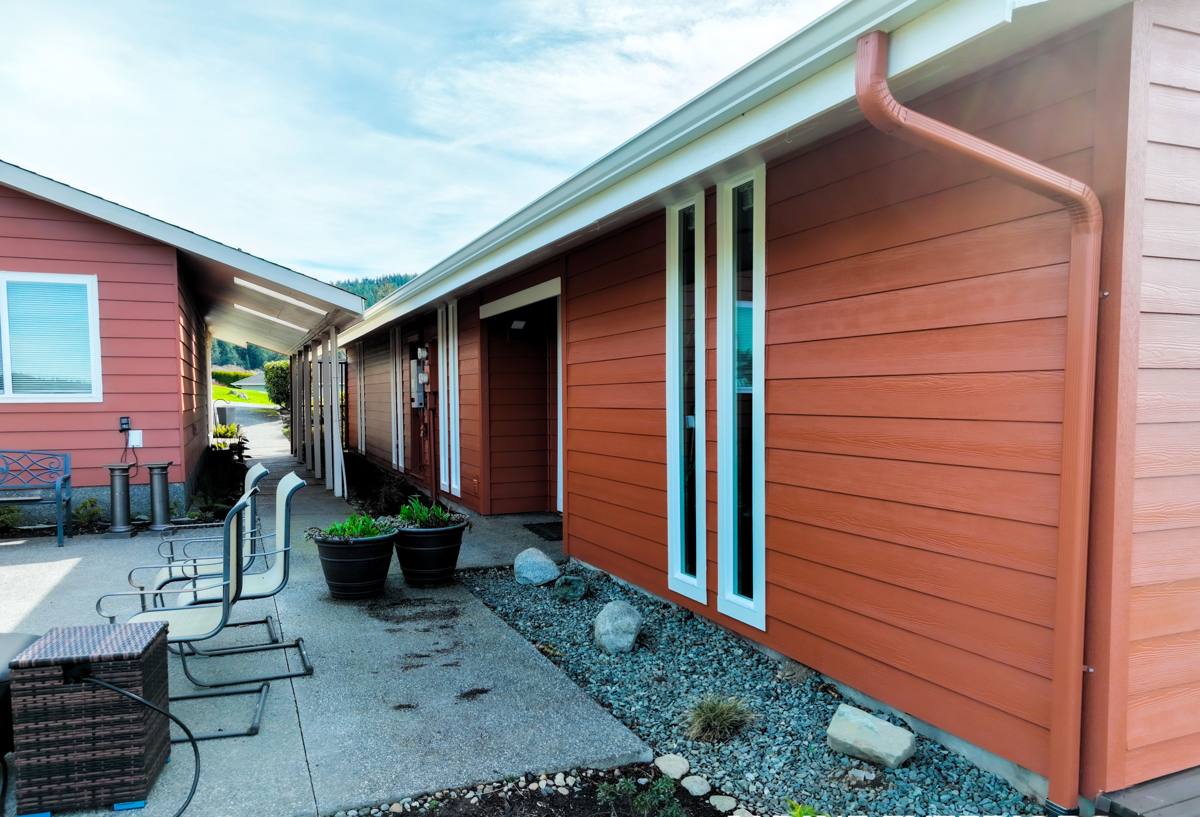
Signs Your Issaquah Home Needs Replacement, Not Just a Repair
Not every siding problem calls for a full tear-off. But in a wet, shaded climate, small problems compound faster than homeowners expect, and patch repairs on failing siding often just delay a bigger bill. Here's what tells us a home needs full replacement rather than a repair:
- Soft or spongy spots when you press on the siding, especially near the bottom courses or under windows
- Visible swelling, bubbling, or delamination — layers of the siding separating from each other
- Persistent moss or dark streaking that comes back within a season of cleaning, on shaded walls in particular
- Paint that won't hold anymore, peeling or bubbling within a year or two of a repaint
- Gaps opening at seams, corners, or trim that let water track behind the siding
- Visible warping or cupping of individual boards or panels
- Interior signs — musty smell, staining, or soft drywall on an exterior wall — that point to moisture getting behind the siding, not just sitting on top of it
If you're seeing more than one or two of these, especially on the shaded side of the house, it's worth a proper inspection before spending money on cosmetic fixes.
What a Correct Siding Replacement Job Actually Involves
Replacement siding is only as good as what's underneath it. A rushed tear-off that just slaps new material over old problems will fail again — often faster than the siding it replaced, since damage that was never addressed keeps working while it's hidden behind a fresh face.
Full Tear-Off and Sheathing Inspection
We remove the old siding down to the sheathing, not just the visible layer, so we can actually see the wall. In a climate like ours, this step is where hidden rot or water damage from years of slow moisture intrusion gets caught — and fixed — before anything new goes on. Skipping this is the single most common shortcut that leads to premature siding failure.
Weather-Resistive Barrier and Flashing
A correctly installed weather-resistive barrier (house wrap) and properly lapped flashing around every window, door, and penetration is what actually keeps bulk water out of the wall assembly — the siding itself is the first line of defense, not the only one. Flashing details at windows, roof-to-wall transitions, and deck ledgers are where the majority of real-world leaks originate, and they're easy to get wrong if a crew is moving fast.
Fastening and Clearances
Fiber cement siding has manufacturer-specified fastener patterns, nailing zones, and minimum clearances from grade, roofing, and decking that exist specifically to manage moisture and allow the material to perform as designed. Ignoring these clearances — a common shortcut on tight lots — is one of the fastest ways to void a warranty and invite exactly the kind of moisture problems the product was engineered to avoid.
Why We Install Only James Hardie Fiber Cement
We standardized on James Hardie fiber cement siding and don't install vinyl, LP SmartSide, or other fiber cement alternatives. That's not a marketing position — it's what we've concluded holds up best to the wet-dry cycling and shade exposure common throughout King County, including Issaquah's tree-lined lots.
Fiber cement is non-combustible, doesn't feed mold the way wood-based products can when they stay damp, and holds paint and factory finishes far longer than materials that swell and shrink with moisture. Hardie's ColorPlus factory finish is baked on under controlled conditions rather than field-applied, which matters a lot in a climate where a fresh field paint job doesn't always get the dry cure time it needs.
Climate-Engineered Product Lines
Hardie makes region-specific formulations — its HZ5 and HZ10 lines are engineered for different climate zones, accounting for moisture exposure and freeze-thaw patterns. For a Puget Sound-region installation, that means the product going on your wall was formulated for conditions like ours, not a generic national spec. We also register installations for Hardie's transferable warranty, which requires installation to their documented spec — another reason we don't cut corners on fastening, clearances, and flashing.
Our Process, Start to Finish
- Walkthrough and estimate — we look at your specific exposure (shade, slope, drainage) and current siding condition, and give you a written estimate with no pressure to decide on the spot.
- Tear-off and sheathing inspection — old siding comes off, sheathing gets inspected, and any rot or hidden damage gets flagged and priced before we move forward.
- Weather barrier and flashing — house wrap and flashing go in correctly at every window, door, and penetration.
- Hardie installation to spec — proper fastener pattern, nailing zones, and clearances, following manufacturer requirements for warranty eligibility.
- Trim, caulking, and final detail — the finish work that determines how clean the job looks and how well water sheds off the wall.
- Final walkthrough — we go over the finished job with you before calling it done.
Cost Factors for Siding Replacement in Issaquah
Every house is different, so we don't quote flat per-square-foot numbers without seeing the home. But these are the factors that most commonly move a bid up or down:
| Factor | Why It Affects the Bid |
|---|---|
| Home size and story count | More wall area and taller walls mean more material, labor, and equipment (lifts, scaffolding) |
| Existing siding material | Some materials are slower and more labor-intensive to remove and dispose of than others |
| Hidden sheathing damage | Rot found during tear-off has to be repaired before new siding goes on — this is priced once it's actually visible |
| Lot access and slope | Sloped or tight lots, common around Issaquah's hillside neighborhoods, can add setup time and equipment needs |
| Trim and architectural detail | Complex trim, multiple gables, and dormers take more time than a simple rectangular wall |
| Siding profile chosen | Lap siding, shingle-style panels, and board-and-batten each have different material and labor costs |
Why Hiring a Crew That Already Works King County Matters
A crew that regularly works Issaquah and the surrounding King County area already knows how local building departments handle permitting for siding replacement, what inspectors here tend to flag, and how to plan around our wet season instead of getting caught mid-project by it. That familiarity shows up in fewer surprises and fewer delays.
It also matters for the details that don't show up on a spec sheet: knowing to pay extra attention to flashing on the shaded, slower-drying side of a house, or recognizing early signs of the kind of moisture damage that's common on tree-covered King County lots versus a drier climate. A crew that's replaced siding on dozens of homes in conditions like these has already seen the failure patterns and knows how to build them out of the new installation.
Maintaining Your New Siding
Correctly installed fiber cement siding is low-maintenance, but "low-maintenance" doesn't mean "no maintenance," especially in a climate that grows moss well. A yearly rinse-down of shaded walls, keeping gutters clear so water isn't sheeting down the siding, and trimming back vegetation that keeps a wall shaded and damp will all extend the life of the job well beyond the base warranty period.
If your Issaquah home is showing signs of siding failure, or you're just tired of losing the fight against moss and paint failure, we'll come take a look and give you a straightforward, no-pressure estimate — use the form below to get started.