 King County
 Why Board & Batten Fits Issaquah Homes
Board and batten has become one of the most requested siding profiles in Issaquah, and it's not hard to see why. The vertical lines read as modern farmhouse on a new build, work just as well on a craftsman remodel, and pair cleanly with the stone, timber, and metal roofing accents common in this part of King County. It's also a profile that holds up visually against a wooded lot — the strong vertical shadow lines don't disappear into the trees the way a flat lap profile can on a shaded elevation.
But the reason we get called out to Issaquah specifically, rather than just quoting a generic siding job, is that board and batten lives or dies on how it's built behind the boards. Done right, it's one of the more durable and low-maintenance profiles available. Done wrong — which happens often with this style, more than with standard lap siding — it traps moisture exactly where a home in this climate can least afford it.
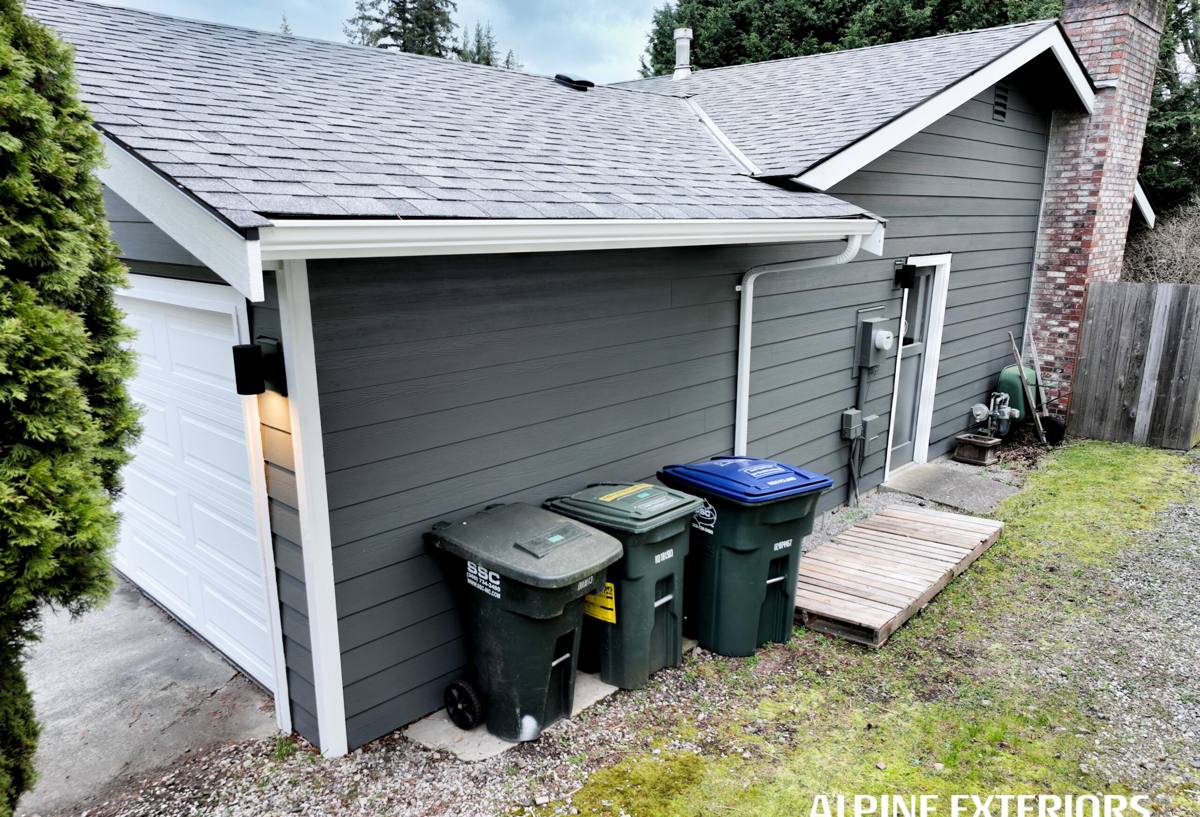
What This Climate Demands From a Board & Batten Wall
King County's marine air, long stretches of driving rain, and a moss season that can run more than half the year all put real pressure on any siding system, but vertical board and batten has its own specific failure points if it's not detailed correctly.
Wind-driven rain and vertical seams
Board and batten relies on vertical seams — either shiplap-style panel joints or the reveal between a board and its batten — running the full height of the wall. On a home with any real wall exposure, wind-driven rain doesn't just fall straight down, it gets pushed sideways into those seams. If the water-resistive barrier, flashing, and fastening pattern behind the boards aren't correct, that seam becomes a wick straight into the wall assembly instead of a shadow line.
Shaded, tree-lined lots
Many Issaquah properties sit close to mature trees or backed against forested slopes. That's great for privacy and curb appeal, and it also means north- and west-facing walls can stay damp for days after a storm passes. Moss, algae, and mildew take hold fastest on siding that doesn't get sun exposure to dry out, and vertical battens create more edges and shadow lines for that growth to establish in if the material itself isn't resistant to it.
Freeze-thaw and moisture cycling
The foothills around Issaquah see colder overnight temperatures and more frost than closer-in Seattle neighborhoods. Any siding material that absorbs water and then goes through a freeze cycle is at risk of cracking, splitting, or delaminating over time. That's a material question as much as an installation question, and it's a big part of why we standardized on one product line rather than installing whatever a homeowner requests.
Getting the System Right: Rainscreen, Battens, and Moisture Path
A correct board and batten installation is really a drainage system with boards on the front of it. The visible battens are the least important part of keeping water out — what matters is everything behind them.
- A continuous, correctly lapped water-resistive barrier behind the entire wall, not just behind the panel joints
- Rainscreen furring strips (or a purpose-built drainage wrap) that create a clear air gap and drainage path behind the siding, so any water that gets past the surface can drain and evaporate instead of sitting against the sheathing
- Proper flashing at every window, door, and horizontal trim transition — board and batten's clean vertical lines make sloppy flashing more visible when it fails, not less
- A fastening pattern that follows the manufacturer's engineered spec for panel size and exposure, not just "what held the last job"
- Weep paths at the base of the wall so water draining down the rainscreen actually has somewhere to exit
Skip any one of these steps and the siding can still look correct for a year or two before problems show up as staining, soft trim, or paint failure at the seams — usually well after the crew that installed it has moved on.
James Hardie Board & Batten: The Only System We Install
We install James Hardie fiber cement exclusively — we don't install vinyl board and batten, LP SmartSide, Cemplank, Allura, or primed wood board and batten, and we won't quote those materials for an Issaquah project. That's a deliberate standard, not a sales preference, and it's worth explaining why for a profile as moisture-sensitive as this one.
Why fiber cement, specifically for this profile
Board and batten depends on straight, stable boards and tight, consistent reveals to look right. Wood-based products expand, contract, and can cup or bow with seasonal moisture, which shows up fast on a profile built around crisp vertical lines. Vinyl board and batten systems are lighter-duty and can't be finished with the same factory paint quality, which matters on a profile where the shadow lines are the whole visual point. James Hardie's fiber cement boards are dimensionally stable, don't absorb water the way wood-based sidings do, and hold a straight line over decades rather than years.
The product line
For board and batten specifically, we work with James Hardie's vertical siding panels paired with matching battens, engineered for the reveal and fastening pattern the profile requires. Hardie's HZ10 formulation is engineered for the Pacific Northwest's wetter, cooler climate zone specifically — it's not a one-size-fits-all product shipped from a warm-climate plant. Boards come with a factory-applied ColorPlus finish, which resists the fading and moss staining that field-painted siding is more prone to, and it carries a manufacturer warranty that follows the home, not just the original owner.
Non-combustible
Fiber cement doesn't burn. With wildfire smoke and ember exposure becoming a more regular late-summer concern even on this side of the Cascades, that's a real, practical advantage over wood-based or vinyl siding — not a marketing point.
What a Correct Installation Looks Like, Step by Step
- Remove existing siding down to the sheathing and assess for hidden rot or moisture damage before covering anything up
- Repair or replace any damaged sheathing — never install new siding over a compromised wall
- Install a continuous water-resistive barrier, correctly lapped from the bottom up
- Install rainscreen furring to create the drainage gap behind the panels
- Flash all windows, doors, and penetrations before a single board goes up
- Install Hardie panels and battens to the manufacturer's fastening and spacing specification
- Detail base, corner, and trim transitions with proper flashing and clearance off the ground
- Caulk and paint touch-up per Hardie's finishing guidelines, using compatible sealants
Our Process, From Estimate to Finished Wall
We start with an on-site look at the home, not a phone quote — board and batten pricing depends heavily on how much of the existing wall assembly needs repair, how many stories and corners the home has, and how much trim detail is involved. We'll walk the exterior with you, point out anything we find (rot, missing flashing, prior water damage) before we ever start tearing off siding, and give you a written scope so you know exactly what's included.
Once work starts, we don't cover up problems we find along the way — if we open a wall and find damage behind the old siding, we stop and talk to you before proceeding, not after. The crew that quotes the job is the crew that shows up to build it, which matters on a profile where the drainage details behind the boards are what actually determines how the wall performs in ten years.
Board & Batten vs. Other Siding Profiles for a King County Home
| Profile | Best fit | Moisture consideration |
|---|---|---|
| Board & batten (Hardie) | Modern farmhouse, craftsman, mountain-modern homes | Vertical seams need a proper rainscreen and flashing; correct fiber cement resists cupping and rot |
| Lap siding (Hardie) | Traditional and transitional homes | Horizontal overlap sheds water naturally; still needs a drainage plane behind it |
| Shingle/shake profile (Hardie) | Craftsman and cottage-style homes | More edges and reveals catch debris and moss; needs the most attention to airflow and drying |
| Mixed profile (accent gables, etc.) | Homes wanting dimension without full board and batten | Transitions between profiles are the most common source of flashing errors |
Many Issaquah homeowners land on a mixed approach — board and batten on gables or an entry feature with lap siding on the main field — which looks great but adds transition points that have to be flashed correctly. That's worth discussing at the estimate stage rather than after materials are ordered.
Cost Factors Specific to Board & Batten in This Area
Board and batten typically costs somewhat more than standard lap siding on a like-for-like home, mainly because of the added labor for battens, rainscreen furring, and more precise layout work to keep reveals consistent. Beyond the baseline material and labor cost, a few things move the number on an Issaquah project specifically:
- Condition of the sheathing once old siding comes off — hidden moisture damage from a previous installation without a rainscreen is common on older homes here
- Wall height and number of stories, since board and batten on a two- or three-story wall needs more scaffolding and careful panel layout
- Amount of trim, corner detail, and window/door count, since each one needs individual flashing
- Access on wooded or sloped lots, which is common in this part of King County and can affect staging and material delivery
- Color selection — factory ColorPlus finishes vary somewhat by shade, but avoid the ongoing cost of repainting entirely
Why a Local King County Crew Matters for This Job
Board and batten forgives fewer mistakes than lap siding, and a crew that only occasionally installs it will make more of them. A crew that regularly works Issaquah and the surrounding King County area already knows the local permitting expectations, has seen how homes in this specific climate — shaded lots, long wet winters, moss buildup — actually perform over time, and isn't learning the rainscreen detailing on your wall for the first time. That local, repeated experience is what turns "it looks right today" into a wall that still looks and performs right in fifteen years.
If you're considering board and batten siding for a home in Issaquah, we're glad to come take a look and walk you through what your specific home would need. The estimate is free, there's no pressure, and you'll leave with a clear, honest scope of work either way.