 King County
 Queen Anne sits on one of Seattle's steepest hills, and a lot of the outdoor living space up here isn't a flat backyard patio — it's an elevated deck built to catch a view over the neighborhood, Elliott Bay, or Lake Union. That elevation is part of why composite decking has become such a common choice on this hill: homeowners want a structure they can actually enjoy for years without babysitting it, and it's often harder to reach for maintenance than a ground-level deck would be. We build and replace composite decks throughout Queen Anne and the rest of King County, and the details that matter most here — framing for a steep or terraced lot, moisture management under a shaded tree canopy, hardware that can hold up to salt-influenced air off the Sound — are different from what a flatter, more sheltered property needs.
What Queen Anne's Hillside and Weather Do to a Deck
Queen Anne's terrain and its weather work on a deck from two directions at once. Because so many lots here sit on a slope, decks are frequently elevated well above grade, cantilevered off the house, or stacked over a lower-level patio — which puts more load on the ledger connection and the framing underneath than a simple ground-level deck ever sees. At the same time, the neighborhood's proximity to Puget Sound means salt-influenced air reaches decks here more than homeowners moving in from inland King County usually expect, and it accelerates corrosion at fasteners, post bases, and any exposed metal hardware. Add the driving rain that blows in off the water during fall and winter storms, plus a long moss season under the mature tree canopy common on the hill's shadier lots, and a Queen Anne deck is carrying a heavier moisture and weather load than a comparable structure somewhere flatter and drier.
None of that makes decking on this hill a losing proposition — plenty of decks up here have held up well for decades. It means the structure and the material need to be matched to the actual site, not picked off a showroom floor without thinking about where the house sits.
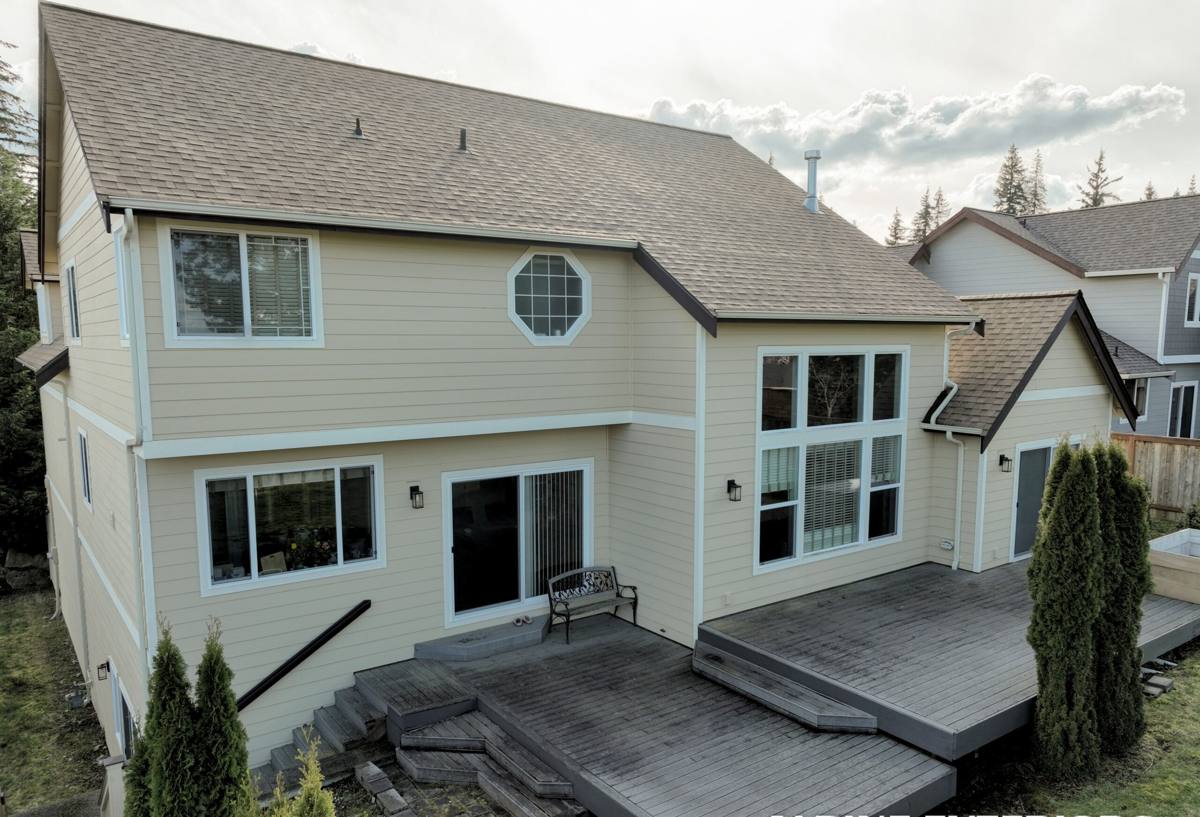
Why Composite Decking Makes Sense on an Elevated, Shaded Lot
Composite decking is a manufactured board, typically a blend of wood fiber and plastic, that doesn't have the same relationship with moisture that solid wood does. It won't cup, splinter, or rot the way a wood board can when it's shaded for long stretches of the day and slow to dry out — a common situation on the tree-covered, north-facing lots scattered through Queen Anne. For a deck that's hard to reach for yearly upkeep because it's elevated two stories up or tucked behind the house, that difference matters more than it would on a deck you walk past and inspect every day.
Capped Composite vs. Older Wood-Plastic Composite
Not all composite decking is built the same way. Early wood-plastic composite boards had exposed wood fiber at the surface, which meant they could still absorb moisture, stain, and support mold or mildew growth if they weren't cleaned regularly — a real liability in a climate with this much sustained dampness. Modern capped composite boards wrap that core in a polymer shell on all four sides, which is what actually gives composite decking its low-maintenance reputation. We install capped composite for that reason; the difference in how the two age over ten or fifteen years on a shaded hillside lot is significant.
What a Correct Composite Deck Installation Involves
The decking boards are the visible part of the job, but the framing underneath is what determines whether the deck is still solid in fifteen years. On Queen Anne's sloped lots, that starts with the ledger — the board that attaches the deck to the house — which has to be properly flashed to keep water from tracking behind it and into the home's wall or floor framing. A poorly flashed ledger is one of the more common sources of hidden rot on older homes, and it's not something you can see once the decking is down.
Framing, Fasteners, and Hardware
We frame with pressure-treated lumber sized for the actual span and load, not the bare minimum a decking manufacturer allows, and we use corrosion-resistant fasteners and structural hardware throughout — a detail that matters more here than it would further inland, given how much salt-influenced moisture this side of King County deals with. Where the decking allows for it, we use hidden fastener systems so the walking surface has no exposed screw heads to collect grime or trap moisture.
Elevated and Multi-Level Structures
Many Queen Anne decks aren't simple rectangles at grade — they're built up on posts to clear a sloped yard, stacked over a lower patio, or wrapped around the side of the house to catch a specific view. Those structures need engineering that accounts for the actual height and load, post footings sized for the soil on that particular lot, and guardrails that meet code for the elevation involved. We treat that structural work as the foundation of the project, not an afterthought to the decking material on top of it.
Composite vs. Wood Decking in Queen Anne's Climate
Homeowners on this hill usually narrow the choice down to two options: a traditional wood deck or capped composite. Both can perform well if the framing underneath is built correctly — the decking material mostly affects how much upkeep the surface needs and how well it holds up to shade, moss, and salt-influenced air over time.
| Factor | Wood Decking | Capped Composite Decking |
|---|---|---|
| Moisture and shade tolerance | Prone to cupping and rot in shaded, slow-drying spots without regular sealing | Resists moisture absorption; performs consistently in shaded areas |
| Moss and surface growth | Organic surface supports growth if cleaning lapses | Less hospitable to growth, though periodic surface cleaning is still needed |
| Salt-air exposure | Fasteners and hardware need regular inspection for corrosion | Board itself is unaffected; hardware still needs to be corrosion-resistant |
| Maintenance routine | Sanding, sealing, or staining roughly every one to two years | Periodic washing; no sealing or staining |
| Upfront cost | Generally lower | Generally higher |
| Cost over 15-20 years | Higher once repeated sealing and board replacement are factored in | Lower ongoing cost and longer typical service life |
The honest answer is that either material can be the right call depending on budget and how much upkeep a homeowner actually wants to commit to. What we won't do is sell composite as maintenance-free — it still needs occasional cleaning — or install a wood deck without being upfront about the sealing schedule it needs to hold up on a shaded, damp lot like many of Queen Anne's.
Permits and Structural Considerations on a Steep Lot
Decks in Seattle generally require a permit once they exceed a certain size or height above grade, and elevated or hillside decks in particular get scrutiny on guardrail height, footing depth, and attachment to the house. On a sloped Queen Anne lot, footing depth and post height often vary from one corner of the deck to the other, which is exactly the kind of detail that needs an actual site assessment rather than a standard plan pulled off a shelf. We handle the permitting and inspection process as part of the job, and we won't cut a structural corner to avoid a permit review — that review exists for a reason, especially on an elevated structure people are going to be standing on.
How We Approach a Queen Anne Deck Project
We start with an on-site look at the lot — the slope, the tree cover, how the new deck will attach to the house, and what the existing structure, if there is one, looks like underneath the surface. From there we put together a straightforward quote that spells out the framing, hardware, and decking material, so there's no ambiguity about what's structural work and what's the visible surface. Once a project is approved, we handle permitting where required, build the framing to the actual load and span, and install the decking with attention to drainage and airflow underneath — details that matter more here than in a drier climate, since trapped moisture under a deck is what eventually causes problems. We clean up the site when the work is finished and walk the completed deck with the homeowner before we consider the job done.
What a Composite Deck Still Needs From a Queen Anne Homeowner
Composite decking is genuinely low-maintenance compared to wood, but low-maintenance isn't no-maintenance, especially under the tree cover and moisture load common on this hill.
- Sweep or rinse off leaves and organic debris regularly, especially in fall — trapped debris holds moisture against the board surface
- Wash the deck once or twice a year with a mild cleaner to prevent surface algae or moss film, particularly on shaded sections
- Keep gutters and downspouts near the deck clear so runoff isn't draining directly onto the decking or the framing below
- Check that furniture feet, planters, and grills aren't trapping moisture against the board surface for extended periods
- Have the substructure looked at every few years, especially the ledger connection, since that part is hidden from daily view
Why Hiring a Crew That Already Works This Hill Matters
Queen Anne's mix of steep lots, narrow access, mature trees, and a housing stock that spans nearly a century of construction means no two decking projects here look quite the same. A crew that works this neighborhood regularly has already worked out how to get material and equipment onto a tight, sloped lot, knows what an older ledger connection typically looks like once it's opened up, and has a feel for which corners of a property hold shade and moisture longest. That kind of judgment comes from doing this work on hillside King County lots repeatedly, not from a general contractor who occasionally takes on a deck between other jobs.
What to Ask Before Hiring
- Ask specifically how they'll handle ledger flashing and attachment to your house, not just which decking brand they carry
- Confirm the framing and footings will be engineered for your lot's actual slope and elevation, not a flat-lot standard plan
- Ask whether fasteners and structural hardware are rated for salt-influenced, marine-adjacent exposure
- Get a clear answer on both the decking manufacturer's warranty and the contractor's workmanship warranty
- Verify the contractor is licensed, bonded, and insured to perform this work in Washington State
Every lot on this hill sits a little differently relative to slope, tree cover, and weather exposure, and the right deck design depends on the specific property — its age, elevation, and how the existing structure, if any, has held up. If you're weighing a new composite deck or a replacement for an aging one in Queen Anne, we're happy to take a look and give you a straight answer on what it actually needs. Reach out for a free, no-pressure estimate — we'll walk the site, talk through the options, and lay out a plan that fits the house and the budget.