 King County
 Why Ballard Decks Wear Faster Than You'd Expect
Ballard sits close enough to Puget Sound that salt-laden air is a daily fact of life for anything built outdoors, and that includes your deck. Combine that with King County's long, wet stretch of fall-through-spring rain and the moss and algae growth that follows, and you get a maintenance load that decks in drier parts of the country simply don't face. A deck that would go a decade without attention in Eastern Washington can develop real structural problems here in half that time if it isn't built, sealed, and maintained with this climate in mind.
Most of the deck repair calls we run in Ballard aren't cosmetic. They start as a soft spot near a post base, a railing that's gotten a little wobbly, or a dark stain that keeps coming back no matter how many times it's cleaned. By the time a homeowner calls, there's often already some wood damage underneath the surface. Catching that early is the difference between a repair that costs a few hundred dollars and one that turns into a full section rebuild.
What Salt Air Actually Does
Salt air doesn't rot wood by itself, but it accelerates corrosion in every metal fastener, bracket, and connector holding your deck together. Once a nail, screw, or joist hanger starts to corrode, it loses grip strength and water gets a path into the wood fiber around it. That's when rot sets in — and it usually starts hidden, inside a joint or under a board, long before it shows on the surface.
What the Rain and Moss Season Adds
King County's wet season means deck surfaces stay damp for extended stretches, especially in shaded yards or under tree cover — common in Ballard's older, well-established residential blocks. Moss and algae thrive in that moisture, and once established they hold water against the wood surface far longer than rain alone would. That constant dampness is what breaks down wood fiber, degrades sealants, and turns a slightly slick deck into a genuinely unsafe one.
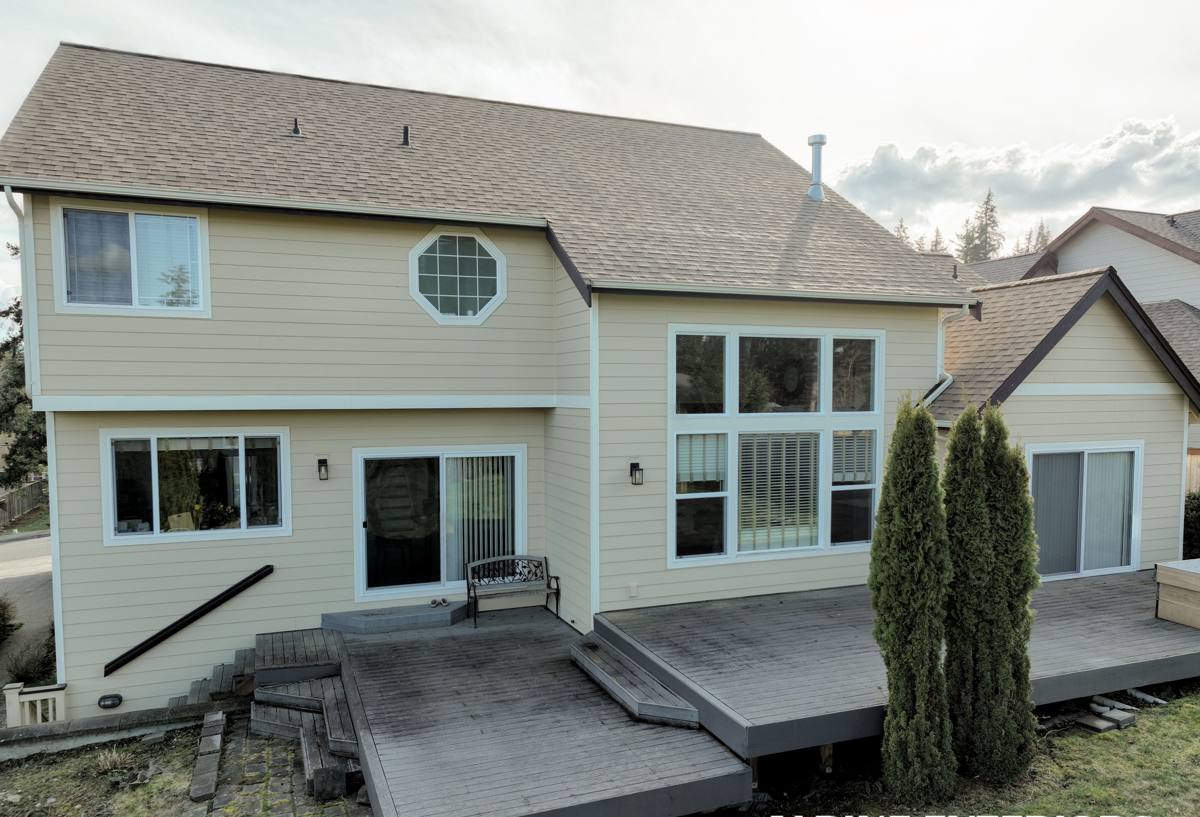
Signs Your Deck Needs Repair — Not Just Cleaning
A power wash and a fresh coat of sealer solves a lot of problems, but not all of them. Here's how to tell which situation you're actually in.
- Boards that feel spongy, springy, or slightly give underfoot when you walk across them
- Railings or posts that wiggle more than a firm push should allow
- Visible gaps opening up between the ledger board and the house
- Rust streaks running down from screws, nails, or metal connectors
- Persistent dark or greenish staining that returns within weeks of cleaning
- Stair stringers that flex or crack under normal foot traffic
- A musty smell coming from underneath the deck structure
- Fasteners that back out or spin freely instead of holding tight
If you're seeing any of the first three items on that list, treat it as a structural question, not a cosmetic one, and get it looked at before the deck sees heavy use again.
What a Correct Deck Repair Actually Involves
A repair that only addresses what's visible from the top often misses the real problem. Water damage travels — it follows fastener paths, runs along joists, and pools wherever drainage is poor. A repair done right starts from the structure and works outward.
Structural Inspection First
Before any board gets replaced, we check the ledger board connection to the house, the condition of the posts and footings, and the joists themselves for soft spots or rot. This is the part of the deck that carries the actual load, and it's also the part that's easiest to patch over without properly checking. A new-looking deck surface can sit on a compromised frame — we won't put fresh boards over a frame we haven't verified.
Fastener and Hardware Review
Given how hard salt air is on metal, we pay close attention to joist hangers, post bases, and structural screws during any repair. Corroded hardware gets replaced with fasteners rated for the exposure — this is a small line item compared to the cost of the wood around it failing again in a few years.
Board Replacement Done Section by Section
Rot rarely stops at exactly one board. We replace damaged decking in full sections, matched as closely as possible to the surrounding material, rather than patching a single board and leaving weakened wood nearby untouched.
Drainage and Airflow Correction
A large share of Ballard deck problems trace back to poor drainage or blocked airflow underneath the structure. Part of a proper repair is making sure water actually sheds off the deck surface and out from underneath it, instead of pooling against framing where it can't dry out between rains.
Wood vs. Composite: What It Means for Repairs
Both materials show up throughout King County, and both can be repaired well — but the repair approach and long-term upkeep differ.
| Factor | Wood Decking | Composite Decking |
|---|---|---|
| Moss/algae resistance | Requires regular cleaning and sealing to resist growth | More resistant, but still needs periodic washing in shaded, damp spots |
| Repair approach | Individual boards can be replaced and blended in fairly easily | Matching older, weathered composite boards to new stock can be difficult |
| Fastener sensitivity | Standard structural fasteners, rated for exposure | Often requires specific hidden-fastener systems per manufacturer |
| Cost to repair a section | Generally lower material cost | Generally higher material cost, less labor for finishing |
| Typical failure point | Surface rot, checking, and fastener pull-through | Substructure (the wood frame underneath) rather than the boards themselves |
One thing worth understanding: composite decking doesn't rot the way wood does, but it's almost always installed over a wood frame. That frame is still exposed to the same salt air and rain we've been describing, so a composite deck isn't maintenance-free — it just shifts where the real risk sits.
Our Deck Repair Process
- On-site assessment. We walk the whole deck, check the frame from underneath where accessible, and test suspect boards and railings by hand rather than guessing from the surface.
- Honest scope. We tell you plainly whether this is a repair, a partial rebuild, or something closer to a full replacement — and why. We're not interested in selling you more work than the deck actually needs.
- Written plan. You get a clear breakdown of what's being replaced, what hardware is being upgraded, and what the finished repair will and won't include.
- The work itself. Structural repairs first, then board and railing replacement, then finish work — sealing or staining as needed to protect the repair going forward.
- Walkthrough. We go over the finished repair with you, including basic guidance on keeping moss and moisture from becoming a repeat problem.
Keeping Moss and Drainage Under Control After the Repair
A repair is only as good as the maintenance that follows it in a climate like this one. A few habits go a long way toward protecting the work:
- Sweep leaves and debris off the deck regularly through fall, since trapped organic matter holds moisture against the boards
- Rinse off moss and algae growth before it gets a chance to establish, rather than waiting for a deep clean once a year
- Keep gutters and downspouts near the deck clear so runoff isn't draining directly onto the deck surface
- Re-seal or re-stain wood decking on the schedule recommended for the product — skipping a cycle in this climate shows up fast
- Check the underside of the deck once a year for early rust or soft-wood spots before they become bigger repairs
What Deck Repair Typically Costs
Costs vary a lot based on how much structural work is involved, so treat this as a general guide rather than a quote.
| Scope of Work | General Cost Factor |
|---|---|
| Cosmetic cleaning and re-sealing only | Lowest cost, no structural work needed |
| Replacing a handful of damaged boards | Moderate, depends on board matching and access |
| Railing or post repair | Moderate, higher if code-related hardware upgrades are needed |
| Ledger board or joist repair | Higher, since it involves opening up the structure |
| Multiple structural issues combined | Approaches the cost of a partial rebuild |
We'd rather give you a real number after seeing the deck than a broad estimate that doesn't match what's actually going on underneath your boards.
Why It Matters to Hire a Crew That Already Works in Ballard
Deck repair isn't the same job everywhere in the country, and it isn't even the same job everywhere in King County. A crew that regularly works in neighborhoods close to Puget Sound already knows to expect accelerated fastener corrosion, knows which drainage details actually hold up through a wet Pacific Northwest winter, and doesn't need to relearn the local moss and algae cycle on your project. That familiarity shows up in fewer surprises and repairs that are built for the conditions your deck will actually face, not generic conditions from somewhere drier.
It also matters for permitting and code compliance. Structural deck repairs — particularly anything touching railings, stairs, or the ledger board connection — can fall under local building code requirements. A contractor who regularly works in the area knows when a repair needs a permit and handles that as part of the job, not as an afterthought.
Get an Honest Look at Your Deck
If your deck has soft spots, a wobbly railing, moss that keeps coming back, or you're just not sure whether it's still safe to use, we're happy to come take a look. The estimate is free, there's no pressure, and you'll get a straight answer about whether you're looking at a simple repair or something bigger — just fill out the form below to get started.