 King County
 Why Queen Anne Homes Need Siding Built for This Exact Climate
Queen Anne sits high above the water, which means the same views that make the neighborhood desirable also expose homes to weather that flatter, inland parts of King County don't deal with as directly. Wind off Puget Sound carries a fine mist of salt air onto siding, trim, and window casings. Add King County's long, wet fall-through-spring stretch of driving rain, and the moss and algae season that can run nine months out of the year on shaded, north-facing walls, and you have a siding assembly that's under nearly constant low-grade attack. It's not dramatic — no single storm damages a Queen Anne home. It's the slow, cumulative wear from moisture cycling, salt exposure, and organic growth that eventually finds every weak seam, every under-caulked joint, and every material that wasn't built for this environment.
That's the lens we use on every Queen Anne project: not "what looks good today," but "what still looks good and performs correctly in twelve years, after a dozen more wet winters."
What Fiber Cement Brings to a Salt-Air, High-Moisture Site
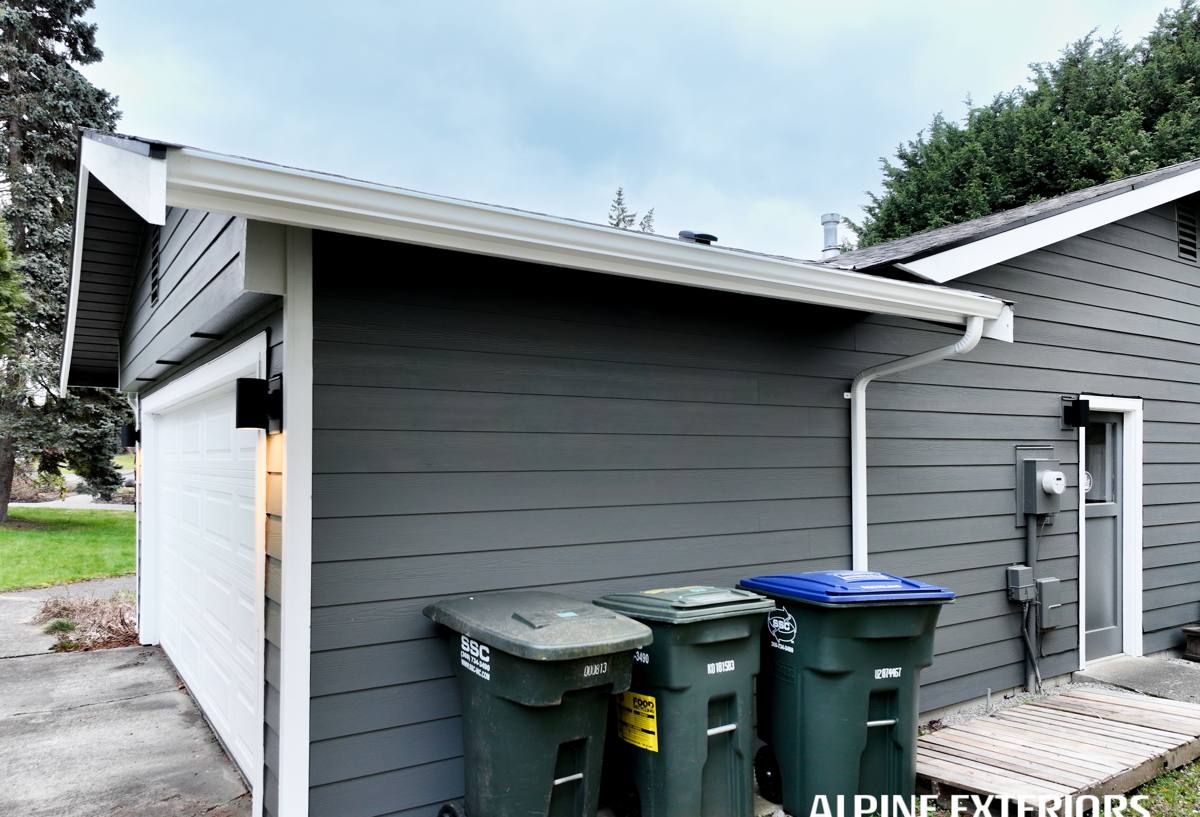
We install James Hardie fiber cement siding exclusively, and on a site like Queen Anne the reasons are practical, not just brand preference. Fiber cement is a cement, sand, and cellulose composite — it doesn't absorb water the way wood-based products do, and it doesn't corrode or pit the way some homeowners worry about with exposed metal trim near salt air. It holds a factory-applied finish (Hardie's ColorPlus system) that's baked on before the siding ever reaches the site, which matters a great deal in a climate where field-applied paint has to cure in unpredictable, often damp conditions.
The three climate factors that actually matter here
- Salt-laden air: fiber cement doesn't rust, corrode, or break down chemically the way some metals and coatings can with prolonged salt exposure.
- Driving, wind-blown rain: correct lap, flashing, and house-wrap detailing keep water moving down and out rather than behind the cladding — the material only performs as well as the install behind it.
- Extended moss and algae season: a factory-cured finish and a properly ventilated rainscreen gap resist the kind of persistent surface moisture that feeds moss and mildew on shaded elevations.
What a Correct Fiber Cement Job Actually Involves
Fiber cement is only as good as the assembly it's installed into. On Queen Anne homes — many with older wall assemblies, a mix of additions, and varied exposure levels between the street-facing side and the water-facing side — we treat the install as a full water-management system, not just a facade swap.
The details we won't skip
- Full tear-off to sheathing on the sides of the house that show any sign of past moisture intrusion, rather than siding over questionable substrate.
- A weather-resistive barrier installed correctly, lapped shingle-style so every seam sheds water downward.
- Rainscreen furring where the wall assembly calls for it, so siding can dry on both faces instead of trapping moisture against the sheathing — especially important on the more sheltered, slower-drying elevations common in this neighborhood's tighter lots.
- Correct flashing at every window, door, deck ledger, and roofline intersection — the majority of siding failures we see start at a poorly flashed penetration, not in the field of the siding itself.
- Factory-cut and factory-primed edges wherever possible, with cut edges properly sealed on site per Hardie's install specs, since an exposed raw edge is where moisture gets in first.
- Correct fastener type, spacing, and embedment — under- or over-driven fasteners are a common cause of premature panel movement and cracking.
Skipping any one of these doesn't usually cause an obvious problem in year one. It shows up in year six or eight, as a soft spot, a stain, or a section that needs to come back off — which is exactly the kind of callback we're trying to prevent by doing it right the first time.
Our Process for a Queen Anne Project
| Step | What Happens | Why It Matters Locally |
|---|---|---|
| 1. Site walk & assessment | We inspect existing siding, trim, flashing, and any visible moisture damage, including shaded and water-facing elevations separately | Queen Anne homes often have very different exposure conditions wall-to-wall — a view-side elevation and a shaded north wall age differently |
| 2. Scope & written estimate | Clear breakdown of tear-off, WRB, rainscreen (where applicable), Hardie product line, and trim package | No surprise change orders once your walls are open |
| 3. Tear-off & sheathing check | Remove old cladding, inspect sheathing, replace any compromised material before anything new goes up | Covering existing rot with new siding just hides the problem |
| 4. Water management install | WRB, flashing, and rainscreen furring installed to spec before siding goes up | This is what actually keeps driving rain out — the siding is the last layer, not the only layer |
| 5. Hardie siding & trim install | Correct lap, fastening, and factory-finish handling per manufacturer spec | Preserves the ColorPlus warranty and gives the finish its full service life against salt air and UV |
| 6. Final walk-through | Joint-by-joint check of caulking, flashing, and trim before we call the job done | Small gaps are easy to catch now and expensive to catch later |
Cost Factors Specific to This Kind of Project
- Substrate condition: homes with hidden moisture damage from a prior siding system typically need sheathing repair, which affects scope more than the siding material itself.
- Elevation and access: Queen Anne's hillside lots, tighter setbacks, and street parking can affect staging and scaffolding logistics compared to a flat suburban lot.
- Trim and detail complexity: older homes with more architectural trim, window casings, and roofline intersections require more flashing and cut work than a simple rectangular elevation.
- Rainscreen inclusion: adding a ventilated rainscreen gap costs more up front but pays off directly on shaded, slow-drying walls where moss and moisture linger longest.
Why Hiring a Crew That Already Works This Neighborhood Matters
Siding installation isn't uniform across King County. A crew that mostly works flatter, more sheltered inland neighborhoods can do fine work there and still underestimate what a hillside, water-exposed elevation in Queen Anne needs — tighter flashing tolerances, more attention to wind-driven rain at corners and eaves, and a realistic read on how long moss-prone walls stay damp. A crew that's worked this neighborhood before already knows which elevations tend to need a rainscreen, which older wall assemblies commonly hide moisture issues, and how the salt air changes the calculus on fasteners and trim.
That local pattern recognition is the difference between a bid that looks complete on paper and a job that actually holds up through a normal Puget Sound winter.
Maintenance Expectations After Installation
Correctly installed Hardie fiber cement is low-maintenance, not no-maintenance. In a climate like this, a bit of homeowner attention goes a long way:
- Rinse siding periodically, especially shaded and water-facing walls, to keep salt residue and organic buildup from accumulating.
- Keep gutters clear so overflow doesn't run down the face of the siding and create a constant damp streak that invites moss.
- Trim back vegetation that keeps a wall section shaded and damp longer than the rest of the house.
- Have caulking at trim joints and penetrations checked every few years — caulk is the one component in the system that wears out before the siding does.
None of this is heavy lifting, but it's the reason a well-installed fiber cement job in this climate can go decades before it needs real attention, versus a system that starts showing problems within a few wet seasons.
Why We Only Install James Hardie
We don't install vinyl, LP SmartSide, primed spruce, cedar, or other fiber cement brands, and on a site like this the reasoning is straightforward. Vinyl can warp and doesn't offer the same fire-resistance profile. Wood-based and primed wood products need consistent maintenance to keep moisture out, which is a harder standard to hold in a climate with this much sustained dampness. Other fiber cement brands may perform reasonably, but we've standardized on Hardie's HZ product lines, which are engineered for specific climate zones, backed by a factory finish warranty, and paired with install specs we've built our whole process around. Standardizing on one system means our crews are deeply practiced on it — not spread across five different manufacturers' quirks — and that consistency shows up in the quality of the finished job.
If you're weighing a siding replacement or repair on a Queen Anne home, we're happy to walk the property, look at your specific exposure and existing wall condition, and give you a straightforward, no-pressure estimate — just fill out the form below.