 King County
 Composite Decking on Mercer Island: Built for the Conditions, Not Just the Look
Mercer Island sits surrounded by water, tucked under a tree canopy, and inside the same wet, gray stretch of weather that defines King County for much of the year. That combination is hard on outdoor wood. Rain doesn't just fall here, it lingers — soaking into end grain, pooling in ledger connections, and feeding moss and algae that get a running start every fall and don't let go until late spring. Add in the marine-influenced air that moves through the Puget Sound corridor and settles over lake properties, and you have conditions that will find every weak point in a deck within a few seasons.
Composite decking was developed largely to answer this exact problem: a wood-alternative board that doesn't absorb water the way lumber does, doesn't need yearly staining, and holds up to repeated wet-dry cycling without cupping, splintering, or graying unevenly. That doesn't mean composite is maintenance-free or that every composite installation performs the same. The board matters, but the installation matters more — and that's where we see the most difference between a deck that looks good for two years and one that still looks good in fifteen.
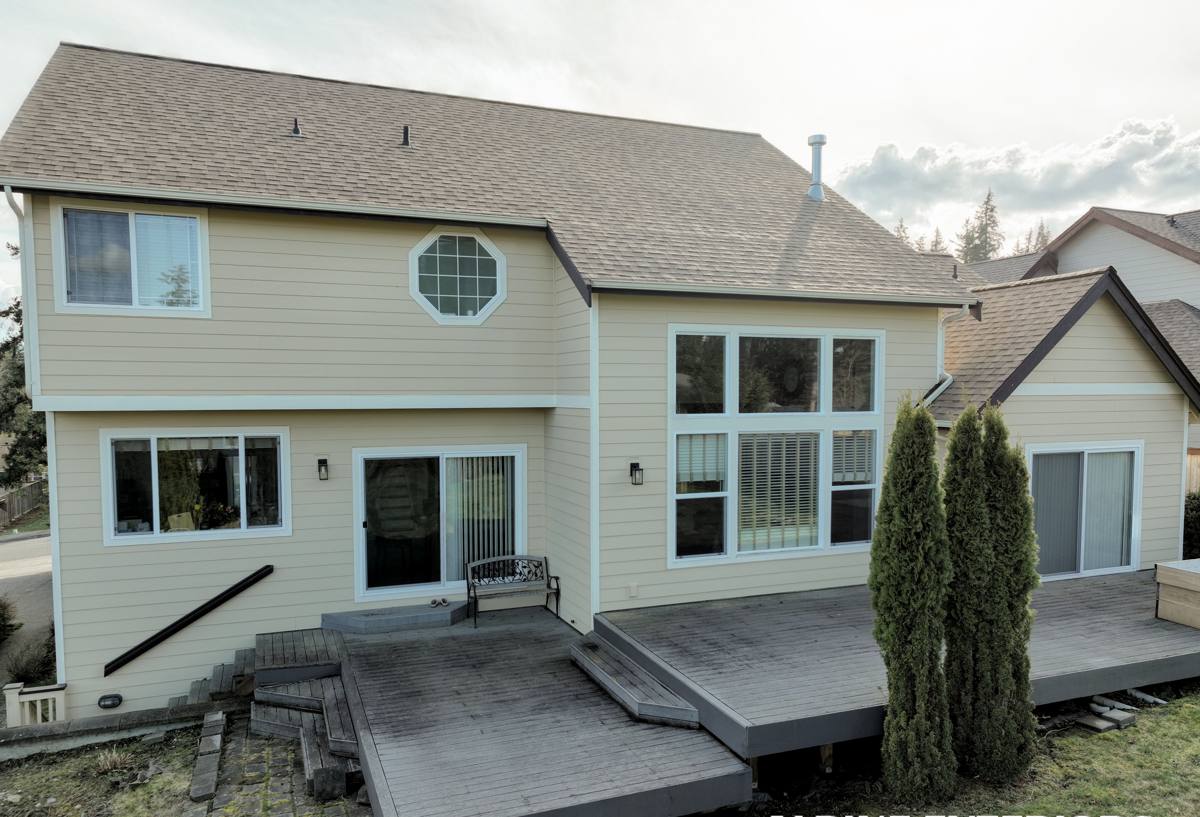
Why Composite Makes Sense for Mercer Island Properties
Mercer Island lots tend to fall into two categories: wooded, shaded interior lots with heavy leaf and needle drop, or open lakefront and view lots exposed to wind-driven rain off the water. Both create their own version of the same problem — sustained moisture contact with the deck surface.
- Shaded lots hold moisture longer between rain events, which is exactly what moss, algae, and mildew need to establish on wood decking.
- Lakefront and view lots see more direct, wind-driven rain, which pushes water into joints, fastener heads, and butt seams that wood decking relies on caulk or sealant to protect.
- Tree cover common across the island means more organic debris settling into board gaps — a maintenance issue for wood, but a much smaller one for composite, which doesn't stain or rot from contact the way lumber does.
Composite doesn't eliminate the need for smart design and regular upkeep, but it removes the single biggest maintenance burden of a King County deck: the annual sand-strip-seal cycle that wood decking demands just to keep water out of the fibers.
What a Correct Composite Installation Actually Involves
The board is only one part of the system. Most early composite deck failures we're asked to look at trace back to substructure and fastening decisions, not the decking material itself.
Substructure and Ventilation
Composite boards need consistent airflow underneath to shed the moisture that collects in our wet season. That means correct joist spacing for the specific board (composite typically requires tighter spacing than wood, especially at angles or diagonal patterns), proper gapping at the ground or hardscape below, and blocking that doesn't trap standing water against the underside of the deck.
Fasteners and Hidden Clips
Composite boards expand and contract with temperature and moisture more than most homeowners expect. Using the manufacturer-specified hidden fastener system, with proper gapping between boards, prevents buckling and keeps water from pooling instead of running off. Face-screwing composite boards without the correct pilot approach is one of the most common corners we see cut on prior installs.
Flashing and Ledger Connections
Where the deck meets the house is the single most water-exposed connection on the structure. Correct flashing at the ledger board, with proper counter-flashing under siding or trim, keeps driving rain from working its way behind the house envelope — a detail that matters as much or more here than the decking material choice itself.
Edge and Fascia Detailing
Cut ends and exposed edges on composite boards need to be capped or protected per manufacturer spec. An exposed, uncapped edge is the one place composite can absorb moisture over time, so this detail isn't cosmetic — it's part of what keeps the board performing as advertised.
Composite Board Options: What Actually Changes Between Tiers
Homeowners are often surprised by how much variation exists within "composite decking" as a category. The differences aren't just cosmetic.
| Board Type | Moisture Performance | Maintenance | Typical Trade-Offs |
|---|---|---|---|
| Capped composite | Strong — protective shell resists moisture and staining | Occasional wash, no sealing or staining | Higher upfront cost than uncapped boards |
| Uncapped composite | Moderate — more prone to surface moisture absorption over time | Periodic cleaning, closer inspection for mold in shaded areas | Lower cost, shorter realistic lifespan in wet, shaded King County lots |
| PVC/composite hybrid | Very strong — minimal organic content to feed mold or algae | Lowest ongoing maintenance | Highest material cost, fewer wood-grain finish options |
We don't push homeowners toward the most expensive tier by default. On a heavily shaded, moss-prone Mercer Island lot, the moisture performance difference between capped and uncapped composite is worth the conversation. On a drier, more open site, a mid-tier capped board is often the right balance of cost and long-term performance.
How Our Process Works
- On-site assessment. We look at sun exposure, drainage, existing structure condition, and how the deck ties into the house before recommending a board.
- Board and layout selection. We walk through the realistic trade-offs for your specific lot — shade, exposure, budget — rather than defaulting to one product line.
- Structural check. Ledger, joists, and footings are evaluated against current code and the load requirements of the new decking, not just visually inspected.
- Installation. Framing corrections, flashing, correct fastener systems, and manufacturer-spec spacing and edge detailing.
- Final walkthrough. We go over what maintenance the specific board you chose actually needs — most composite decks need far less than homeowners assume, but "none" is rarely accurate.
Problems We Commonly Fix From Prior Installations
A fair amount of our composite decking work on Mercer Island is repair or partial rebuild work following an installation — sometimes a DIY job, sometimes a rushed contractor job — that skipped a structural detail. The patterns repeat:
- Boards installed tight with no expansion gap, leading to buckling after a wet winter followed by a hot summer.
- Face-screwed boards where the fastener pattern was never designed for the composite's expansion behavior.
- Ledger boards without proper flashing, leading to moisture intrusion behind siding that isn't visible until it's a larger repair.
- Joist spacing built for wood decking, left as-is for a composite install that needed tighter support.
None of these are composite decking failures — they're installation shortcuts that composite decking, done correctly, is specifically designed to avoid.
Maintenance: What Your Deck Actually Needs Here
Composite is low-maintenance, not no-maintenance, and King County's long wet season and moss pressure mean a couple of habits matter more here than they would in a drier climate.
- Rinse or sweep debris out of board gaps periodically, especially under tree cover, so organic material doesn't sit against the surface through the wet months.
- Wash the deck surface with a soft-bristle brush and mild soap once or twice a year — a pressure washer on too high a setting can damage the capped surface of some boards.
- Check fastener lines and board ends annually for any movement, especially after the first full wet-to-dry seasonal cycle.
- Keep gutters and downspouts near the deck clear so runoff isn't directed onto or under the decking.
Why Hire a Crew That Already Works Mercer Island
Building codes, permitting requirements, and even structural expectations shift by jurisdiction, and Mercer Island has its own permitting process separate from unincorporated King County. A crew that already works on the island knows the permitting steps, understands the site-access realities of narrow lots and shared driveways common here, and has seen firsthand how the lake-influenced, tree-shaded conditions on a given street behave differently than a more open, inland King County lot. That local track record shows up in fewer surprises — during permitting, during installation, and in how the deck performs three winters from now.
Is Your Deck Ready for a Composite Rebuild? Quick Checklist
- Boards showing splintering, graying, or soft spots despite regular sealing
- Persistent moss or algae growth that returns within weeks of cleaning
- Visible gaps, movement, or squeaking at fastener points
- Staining or discoloration near the ledger board where it meets the house
- A deck older than 12-15 years that hasn't had a structural inspection
If two or more of these sound familiar, it's worth having someone look at the structure before deciding whether you need a full rebuild or a more targeted repair.
If you're weighing composite decking for a Mercer Island property, we're glad to walk the site, look at your existing structure, and talk through what board and layout actually fits your lot's sun, shade, and drainage. Use the form below to request a free, no-pressure estimate.