 King County
 Storm Damage in Redmond: What Our Climate Does to Roofs
Redmond sits close enough to the water and low enough in elevation that roofs here take a steady, cumulative beating rather than one dramatic hit. It's rarely a single catastrophic storm that ruins a roof in King County — it's the pattern. Salt-tinged air moving off Puget Sound corrodes exposed metal flashing and fasteners over time. Wind-driven rain, especially during fall and winter frontal systems, gets pushed sideways under shingle edges and around penetrations that would stay dry in a calmer climate. And a long, wet moss season — often eight or nine months of the year — keeps organic growth working into shingle mat and holding moisture against the roof deck long after the rain stops.
Storm damage repair in this environment isn't just about patching what a wind event tore loose. It's about recognizing that most of what looks like "storm damage" is actually storm damage layered on top of moss, granule loss, and slow moisture intrusion that was already underway before the wind picked up. A repair that only addresses the visible tear or missing shingles, without accounting for what the storm exposed underneath, tends to fail again at the next system that rolls through.
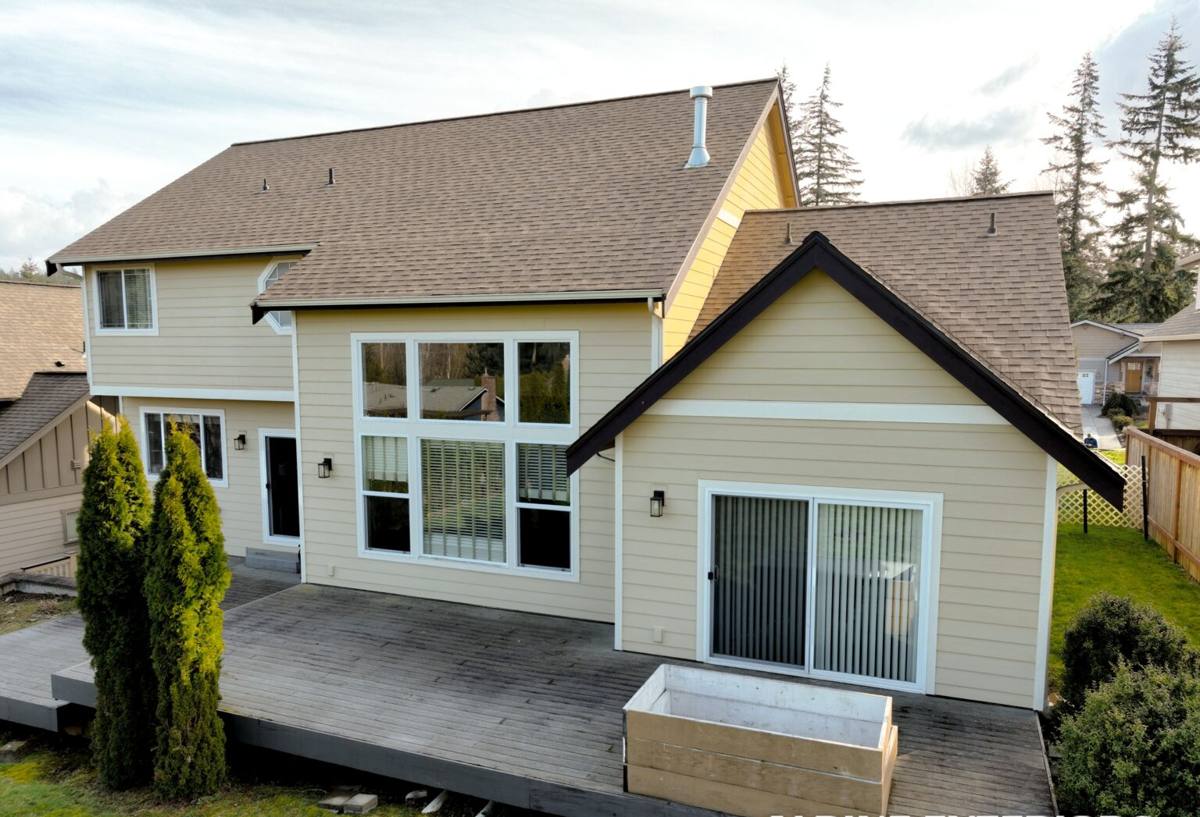
Common Types of Storm Damage We See in Redmond
Every storm is different, but the damage patterns in this area repeat. Knowing what to look for helps you decide how urgent a repair is.
Wind Damage
Gusty fall and winter storms lift and crease shingles, especially along ridges, hips, and roof edges where wind uplift is strongest. Sometimes shingles blow off completely; more often they're loosened or creased without fully detaching, which is harder to spot from the ground but just as likely to leak.
Wind-Driven Rain Intrusion
Because our rain often comes in sideways rather than straight down, water finds its way under shingle tabs, around chimneys, skylights, and vent boots, and along step flashing that's lost its seal. This shows up as ceiling stains, damp attic insulation, or musty smells well after the storm has passed.
Debris Impact
Mature trees are part of the character of Redmond neighborhoods, but limbs and branches coming down in a windstorm can crack shingles, dent metal roofing, or puncture the roof deck outright. Even small branch strikes can compromise a shingle's water-shedding ability without an obvious visible hole.
Moss-Weakened Areas That Finally Give Way
A roof section that's been holding moisture under a moss mat all season is already softened by the time a storm arrives. The storm doesn't create the weakness — it exploits it, turning a slow leak into a sudden one.
What a Correct Storm Damage Repair Actually Involves
A rushed storm repair — a few new shingles nailed over the damaged spot, some fresh caulk around a vent — will often hold for a season and then fail again. A correct repair works in a specific order:
- Full damage mapping, not just the obvious spot. We check the whole roof plane, not just where the leak is showing inside, because wind and rain damage rarely stay confined to one shingle.
- Deck inspection where shingles are removed. If water has been getting to the sheathing, we need to know before we cover it back up. Soft, delaminating, or stained decking gets replaced, not papered over.
- Underlayment continuity. Storm repairs that skip proper underlayment tie-in at the patch edges create a new weak seam exactly where the old damage was.
- Flashing before shingles. Most storm leaks in this region trace back to flashing, not field shingles — step flashing at walls, counter-flashing at chimneys, and boots at pipe penetrations. We address these first, since new shingles over bad flashing just hide the problem.
- Matching materials and proper fastening. Shingles are nailed to withstand regional wind loads, not just tacked in place, and we match existing material as closely as possible so a repair doesn't stand out as an obvious patch.
Our Process From Call to Completed Repair
Storm damage repair moves faster than a full re-roof project, but it still follows a consistent sequence so nothing gets missed under time pressure.
1. Initial Assessment
We walk the roof and the attic where accessible, photograph the damage, and check for secondary issues — moss buildup, granule loss, or aging flashing nearby that a storm may have finished off.
2. Temporary Protection
If there's an active leak or exposed decking, we get a tarp or temporary seal in place quickly to stop further water intrusion while the permanent repair is scheduled and materials are sourced.
3. Written Scope and Estimate
You get a clear, itemized scope before any work starts — what's being repaired, what materials are used, and what the price covers. No surprise add-ons mid-job.
4. Repair Work
Deck repair if needed, flashing correction, underlayment tie-in, and shingle or roofing material replacement, done in that order so each layer is protecting the one below it correctly.
5. Final Walkthrough
We show you what was found and what was fixed, including anything we'd recommend keeping an eye on going forward — particularly moss regrowth or aging flashing elsewhere on the roof that wasn't part of this storm's damage but is worth planning for.
Repair vs. Replacement: How We Make the Call
Not every storm-damaged roof needs full replacement, and not every roof is a good candidate for another round of patch repairs. Here's how we generally think about it:
| Factor | Leans Toward Repair | Leans Toward Replacement |
|---|---|---|
| Roof age | Under 12-15 years, asphalt shingle | Nearing or past manufacturer's expected service life |
| Damage extent | Localized to one or two roof planes | Widespread across multiple planes or slopes |
| Deck condition | Sound, dry sheathing under damaged area | Soft, delaminated, or repeatedly wet decking |
| Moss/moisture history | Minimal prior moss or leak history | Long-term moss buildup or recurring leaks in multiple spots |
| Shingle condition elsewhere | Rest of roof still has good granule coverage and flexibility | Widespread granule loss, brittleness, or curling |
We'll tell you honestly if a repair is the right call, and just as honestly if patching a tired roof is throwing money at a short-term fix. Our goal is to solve the problem correctly, not to upsell a replacement a roof doesn't need yet.
Insurance Claims and Storm Damage
Many storm damage repairs in King County involve a homeowner's insurance claim, especially after a named windstorm event. A few things make that process go smoother:
- Document damage with photos as soon as it's safe to do so, before any temporary repairs cover it up
- Get a written, itemized repair estimate — adjusters generally respond better to specifics than vague damage descriptions
- Ask us to point out storm-caused damage versus pre-existing wear, since insurers distinguish between the two and it affects what's covered
- Keep receipts and documentation for any emergency tarping or temporary protection, which is often reimbursable
- Don't sign a full contract until you know what the adjuster's estimate actually covers
We're happy to provide documentation and meet an adjuster on-site if that helps move your claim along. We work for you, not the insurance company, and we'll say so plainly if we think an initial estimate is missing damage.
Materials We Use for Storm Repairs and Why
For most storm repairs on asphalt shingle roofs, we match existing shingle type, profile, and as close a color as is still manufactured, since discontinued colors are common on older roofs. For flashing, we use metal flashing systems designed for proper water-shedding at transitions — step flashing at wall intersections, counter-flashing at chimneys, and pipe boots rated for regional temperature swings and UV exposure rather than generic hardware-store versions that harden and crack faster in our climate.
We're selective about underlayment as well. In a climate with this much sustained moisture exposure, a synthetic underlayment with good wind and water resistance at seams matters more here than in drier regions, since it's the layer doing the work if wind-driven rain gets past the shingles at all.
Why We Don't Take Shortcuts on Flashing Products
It's tempting on a storm repair to reuse existing flashing if it looks intact, since it saves time and cost. Our standard is to inspect flashing closely rather than assume it's fine just because it isn't visibly torn — corrosion from salt air and years of thermal cycling can leave flashing brittle or improperly seated even when it looks okay from a distance. Replacing questionable flashing during a repair costs less than a callback for the same leak six months later.
Why a Redmond-Based Crew Matters
A roofing crew that regularly works Redmond and the surrounding Eastside neighborhoods has a working knowledge of how this specific stretch of King County behaves — which roof orientations take the worst of the wind-driven rain, how aggressively moss regrows under our tree cover, and what flashing details tend to fail first on the housing stock common to this area. That local pattern recognition speeds up diagnosis and reduces the chance of missing a related issue that a crew from outside the region might not think to check.
There's also a practical response-time benefit. Storm damage that's actively letting water in doesn't wait for a convenient schedule slot, and a crew based in the area can typically get a temporary protection measure in place faster than one traveling in from farther out.
Cost Factors for Storm Damage Repair
Every roof and every storm event is different, so we don't quote pricing sight unseen. What we can share is what actually moves the cost:
| Factor | Impact on Cost |
|---|---|
| Area of damage | Larger increases material and labor time |
| Deck replacement needed | Adds cost if sheathing is soft or rotted |
| Roof pitch and access | Steeper or harder-to-reach roofs take longer and require more safety setup |
| Flashing scope | Full flashing replacement at chimneys/valleys costs more than field shingle repair alone |
| Shingle matching | Older or discontinued shingle colors may require a wider blend area to avoid a visible patch |
| Emergency vs. scheduled work | Emergency tarping and after-hours response typically carries a premium |
We give you an honest, itemized estimate after seeing the actual damage — no generic per-square pricing that doesn't reflect what your roof actually needs.
Get a Free, No-Pressure Estimate
If a recent storm has left you with a leak, missing shingles, or damage you're not sure how to assess, we're glad to take a look. There's no obligation and no pressure — just a straightforward inspection, an honest read on what's actually going on, and a clear estimate if repair work is needed. Fill out the form below and we'll get back to you to schedule a time.