 King County
 Woodinville's Climate and What It Does to Siding
Woodinville sits in a wooded, valley-shaped pocket of King County, and that setting cuts both ways for a home's exterior. The tree canopy and river-valley humidity that make the area attractive also keep siding damp longer after every rain than it would stay in a more open, sun-exposed neighborhood. Combine that with the long, gray stretch of driving rain King County sees from fall through spring, and you get a moss season that can run half the year on north-facing walls and anywhere shaded by mature trees or a neighboring structure.
Moss and algae aren't just cosmetic. They hold moisture against the siding surface, and sustained moisture is what breaks down paint film, swells wood-based products, and eventually finds its way behind panels through gaps, nail holes, and failed caulk joints. Homes throughout the wider Puget Sound region deal with the same marine-influenced weather pattern — persistent humidity, seasonal wind-driven rain, and short drying windows — and Woodinville's tree cover often means slower drying than homes on more open lots even a few miles away.
None of this means Woodinville siding is doomed to fail early. It means repairs have to account for why the damage happened, not just patch what's visible.
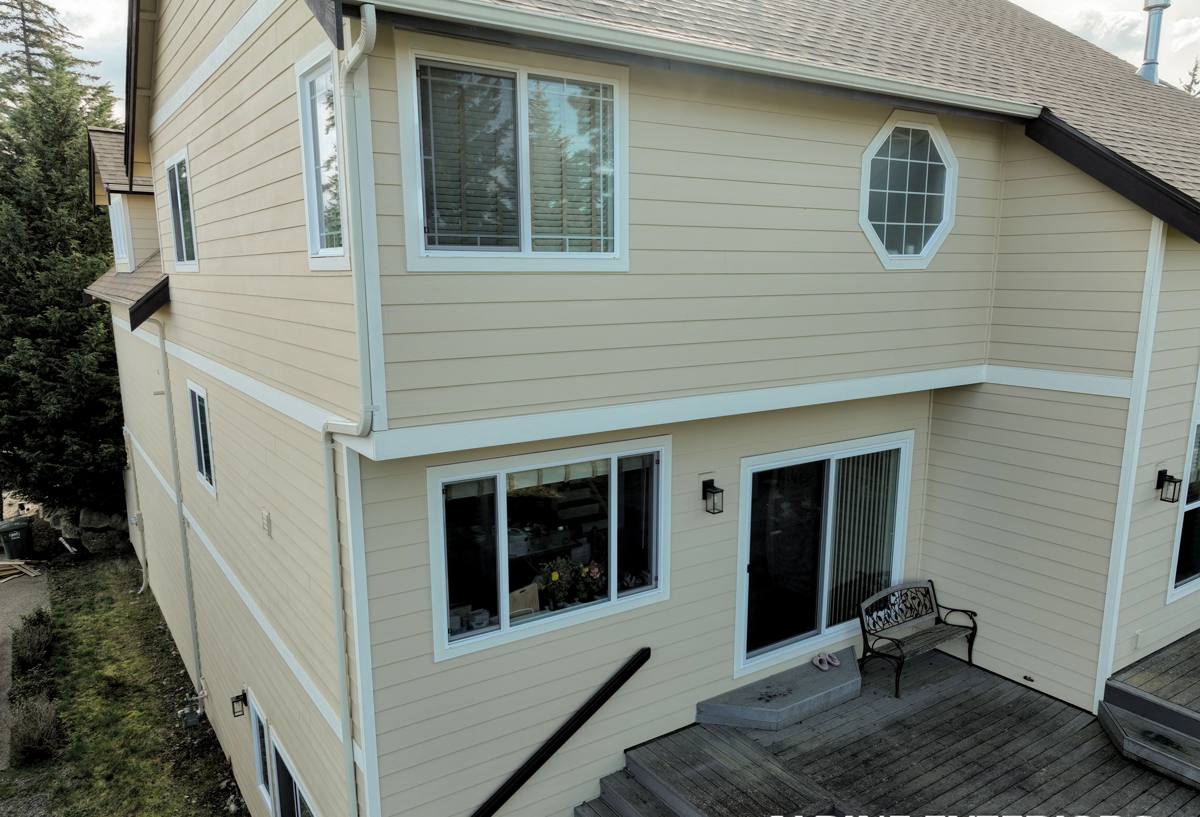
Signs Your Siding Needs Repair vs. Replacement
One of the most common questions we get on a Woodinville estimate is whether a problem area can be repaired or whether it's a sign the whole elevation needs to come off. The honest answer depends on how far the damage has traveled behind the surface.
- Repair is usually enough when damage is localized — a cracked or split panel from an impact, a section pulling away from fasteners, caulk failure at trim and window returns, or isolated moisture staining that hasn't reached the sheathing.
- Replacement of a section (or the whole elevation) is the right call when you find soft or spongy sheathing behind the siding, staining that's spread across multiple panels, siding that's buckled or bowed from trapped moisture, or the underlying house wrap/flashing has failed and is letting water in systematically rather than at one spot.
- A gray area — and one worth a real inspection rather than a guess — is older wood-based or engineered wood siding that's showing edge swelling or delamination in more than one place. That pattern usually means the product is failing broadly, even if only a few boards look bad today.
We won't sell a full re-side when a targeted repair will hold, and we won't patch a wall that's telling us the problem is bigger than what's visible.
Common Siding Repair Issues We See in Woodinville
Moisture and Moss-Related Damage
Shaded, north- and west-facing walls in wooded Woodinville lots are the most frequent repair calls. Moss buildup traps water against the siding face, and if the siding is an older painted wood product or a lower-grade composite, that sustained dampness leads to swelling, paint failure, and eventually soft board sections.
Caulk and Joint Failure
Every siding system relies on caulking and flashing at butt joints, window and door trim, and penetrations for vents or fixtures. In a climate with this much seasonal rain, caulk has a shorter useful life than most homeowners expect. Once it cracks or pulls away, water gets behind the cladding at exactly the points designed to keep it out.
Impact and Mechanical Damage
Cracked or dented panels from storms, falling branches (common on wooded Woodinville properties), or general wear happen regardless of climate. These are usually the simplest and most affordable repairs, provided the damage is caught before water gets in behind the crack.
Fastener and Attachment Problems
Panels installed with the wrong fastener pattern, over-driven nails, or insufficient gapping for expansion can work loose or crack over time — often years after the original install. This is one of the more common issues we find on homes that weren't originally sided by a crew specializing in fiber cement.
What a Correct Siding Repair Actually Involves
A repair that just covers the visible problem tends to fail again within a season or two. A repair done right addresses three layers, not one:
- The surface — removing and replacing the damaged panel or trim piece, matched to the existing product and profile.
- The water management layer — checking and correcting the house wrap, flashing, and caulk joints behind and around the repair so the same failure doesn't recur.
- The substrate — inspecting the sheathing underneath for soft spots or rot. If we find compromised sheathing, that gets addressed before any new siding goes back on. Covering over damaged sheathing is the single most common shortcut that leads to a "repaired" area failing again.
Color and texture matching also matters more than people expect. James Hardie's ColorPlus factory finish is baked on and UV-cured, which means a properly matched replacement panel from current inventory blends in — but on older installations, some fading is normal, and we'll tell you upfront if an exact match isn't realistic so you're not surprised by a slightly visible repair seam.
Our Repair Process
1. Inspection and Diagnosis
We start by identifying not just what's damaged, but why. That means checking behind a sample area when moisture is suspected, looking at drainage and grading near the foundation, and checking gutters and downspouts — a surprising number of "siding problems" in Woodinville trace back to water being dumped against a wall rather than a siding defect itself.
2. Honest Scope
You get a clear explanation of what's a spot repair, what's a section replacement, and what — if anything — points to a larger issue. No inflated scope, no downplaying a problem to make the estimate look smaller.
3. The Repair Itself
Damaged material comes out, the water management layer gets corrected, and new material goes in fastened and caulked to manufacturer spec. On James Hardie homes, that means following Hardie's fastening, clearance, and joint-treatment guidelines exactly — those specs exist because deviations are what cause premature failures.
4. Final Check
We walk the repair with you, confirm the finish and caulk lines meet our standard, and flag any other areas worth keeping an eye on so small issues don't turn into next year's repair call.
Repair Cost Factors
Every Woodinville repair is different, but the price generally depends on a handful of factors. This table gives a general sense of what drives cost up or down — it's not a quote, since scope varies once we're actually behind the siding.
| Factor | Lower Cost | Higher Cost |
|---|---|---|
| Damage extent | Single panel, easy access | Multiple panels, spread across elevation |
| Access | Ground level, clear approach | Second story, tight landscaping, requires staging |
| Underlying moisture | Surface-only, dry sheathing | Soft or rotted sheathing needing replacement |
| Color match | Recent Hardie ColorPlus, current inventory | Older or discontinued color, field-painted match |
| Cause | Isolated impact damage | Systemic flashing/water-management failure |
Why We Repair — and Recommend — James Hardie Specifically
We install only James Hardie fiber cement siding, and that shapes how we approach repairs too. Hardie's HZ5 product line is engineered for the kind of freeze-thaw and moisture cycling the Pacific Northwest sees, it's non-combustible, and the ColorPlus finish is designed to resist the fading and chalking that plagues field-painted products in a climate this wet. When we repair a Hardie home, we're working with a product that's dimensionally stable and consistent, which makes color and profile matching realistic in a way it often isn't with vinyl, LP SmartSide, or painted wood siding that's absorbed years of Woodinville moisture unevenly.
If your home currently has a different siding product and the damage is extensive enough that repair isn't the right call, we'll say so — and we'll explain honestly why we'd recommend Hardie for the replacement rather than matching what's there now.
Why Hire a Crew That Already Works Woodinville
Siding repair looks straightforward from the outside, but a crew unfamiliar with the local building patterns and climate behavior can miss the actual cause of a problem. A contractor who regularly works Woodinville and the surrounding King County area already knows which elevations tend to hold moss, how local tree cover affects drying time, and what moisture patterns look like on wooded lots versus open ones. That local pattern recognition is often the difference between a repair that fixes the root cause and one that just covers a symptom.
It also means faster, more accurate estimates — we're not learning the area's quirks on your dime — and a crew that can speak plainly to what's normal wear for this climate versus what's an actual defect worth addressing now.
Checklist: What to Ask Before Hiring a Siding Repair Contractor
- Will they inspect behind the damaged area, or just estimate from what's visible on the surface?
- Do they check flashing, house wrap, and caulk joints as part of the repair, not just replace the panel?
- Can they explain why the damage happened, not just what it looks like?
- Do they work with the specific siding product on your home, and can they source a real color/profile match?
- Are they willing to tell you honestly when a repair won't hold and replacement is the better long-term move?
- Do they carry proper licensing and insurance for exterior work in Washington?
If you're seeing moss buildup, cracked panels, or damp staining on your Woodinville home, it's worth getting an honest look before the problem spreads. We offer free, no-pressure estimates — use the form below to get one scheduled.