 King County
 Why Bothell Homes Wear Through Siding Faster Than You'd Expect
Bothell sits in one of the wetter corners of King County, and that shows up on the outside of a house long before it shows up anywhere else. Homes here go through an extended wet season where siding stays damp for days at a stretch, followed by short bursts of hot, dry summer that stress whatever moisture got trapped underneath. Add in the tree cover that's common across Bothell's older neighborhoods and newer developments alike, and you get a steady cycle of shade, moisture, and organic buildup that most siding products simply weren't engineered to handle for decades on end.
Driving rain is the biggest factor. When wind pushes rain sideways against a wall instead of letting it run straight down, water finds every seam, nail hole, and butt joint a siding system has. Over years, that's how rot starts behind wood-based products and how lower-grade composites start to swell, bubble, or delaminate. A long moss season doesn't help — moss and algae hold moisture against the surface even after the rain stops, which keeps siding wet far longer than the label ever accounted for. None of this is unique to one street or one subdivision; it's the baseline reality of building an exterior in this part of King County, and it's the reason siding replacement here needs to be treated differently than it would in a drier climate.
What This Means in Practice
It means the siding material matters more here than almost anywhere else, and so does the installation detail behind it — flashing, gaps, fastening, and drainage all have to be right, because the climate won't forgive shortcuts the way a dry-summer climate might.
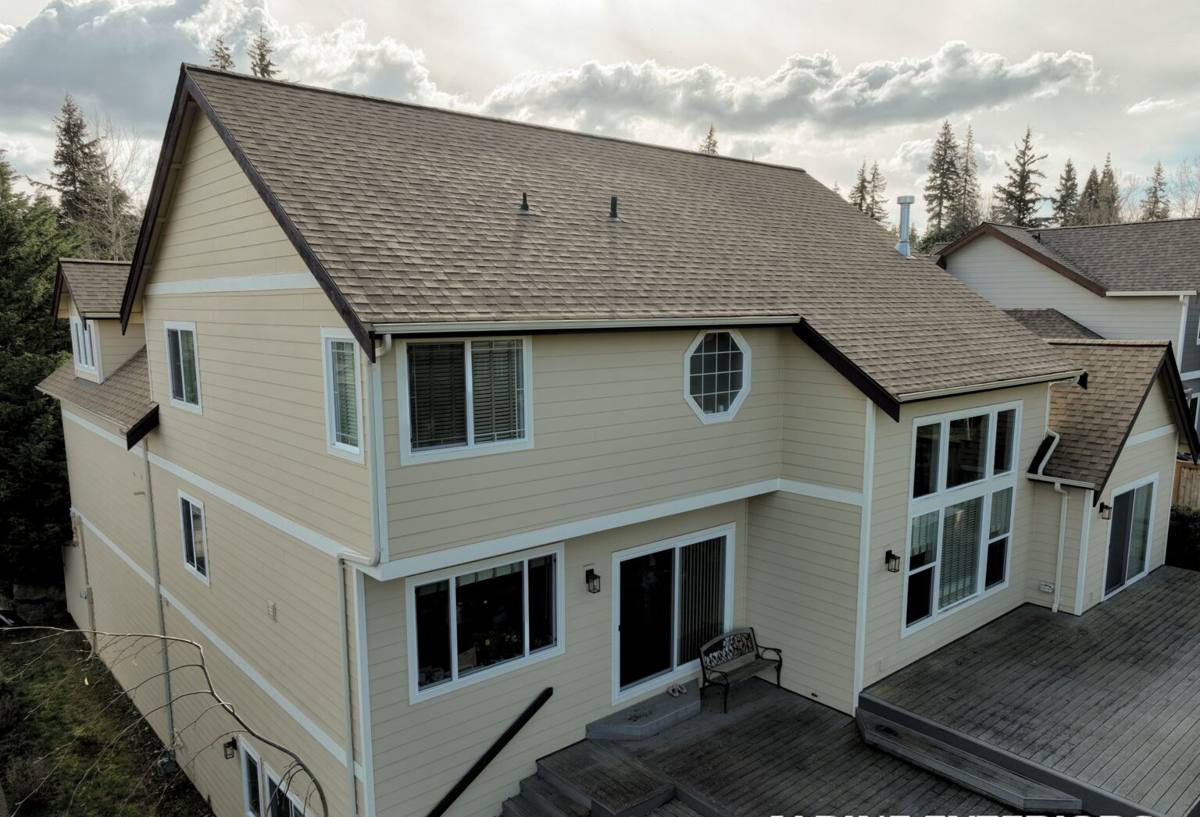
Signs a Bothell Home Needs Replacement, Not Just Repair
Not every siding problem calls for a full tear-off. But there's a point where patching individual boards or panels stops being a real fix and starts being a delay tactic. Knowing the difference saves homeowners from spending repair money on a wall that needs to come off anyway.
- Soft or spongy spots when you press on the siding, especially near the bottom courses or below windows
- Paint that keeps failing in the same spots within a year or two of repainting
- Visible warping, buckling, or boards pulling away from the wall
- Persistent moss or dark staining that comes back within weeks of cleaning
- Soft trim or sheathing discovered when a section of siding is pulled off
- Siding that's original to a home built more than 25–30 years ago, especially wood or older composite products
- Interior signs like musty smells, peeling interior paint, or damp drywall on exterior-facing walls
If you're seeing two or more of these at once, that's usually a sign the moisture problem has moved past the surface and into the wall assembly — which is a replacement conversation, not a caulk-and-paint one.
Why We Only Install James Hardie Fiber Cement
King County Siding installs one siding system: James Hardie fiber cement. We don't install vinyl, LP SmartSide, Cemplank, Allura, primed spruce, or cedar, and that's a deliberate standard, not a lack of options. Each of those products has legitimate uses and, in some cases, a lower upfront price. But in a climate like Bothell's, the trade-offs that come with them — moisture sensitivity in engineered wood products, expansion and contraction issues in vinyl, the ongoing maintenance burden of real wood, and the inconsistent long-term performance of some composite panels — are trade-offs we're not willing to put our name behind.
Fiber cement is non-combustible, dimensionally stable across our wet-to-dry swings, and doesn't feed moss or rot the way wood-based siding can. James Hardie's ColorPlus factory-applied finish is baked on under controlled conditions rather than field-painted, which matters a lot in a region where a freshly painted house can see rain within days of a repaint. It's also backed by a strong, transferable warranty when installed to the manufacturer's specifications — something we take seriously, because an improperly installed Hardie job won't perform the way the product is capable of performing.
What a Correct Siding Replacement Actually Involves
Siding replacement isn't just removing old boards and nailing up new ones. In a climate that pushes water at walls as often as ours does, the work that happens before the new siding goes up is what determines whether the job lasts 10 years or 40.
| Stage | What Happens | Why It Matters in Bothell's Climate |
|---|---|---|
| Tear-off | Old siding and trim removed down to the sheathing | Exposes hidden rot or damaged sheathing before it's covered up again |
| Sheathing repair | Any soft, rotted, or delaminated sheathing is cut out and replaced | Covering damaged sheathing with new siding just hides the problem |
| Water-resistive barrier | Housewrap or building paper installed correctly, lapped to shed water downward | This is the real waterproofing layer — siding is the weather deflector, not the seal |
| Flashing | Windows, doors, and penetrations flashed to direct water out and down | Most rot starts at flashing gaps around openings, not on flat wall sections |
| Furring or rainscreen gap (where called for) | A small air gap behind the siding to let moisture drain and dry | Helps siding dry out between our long stretches of wet weather |
| Fiber cement installation | James Hardie planks or panels installed per manufacturer fastening and clearance specs | Correct nailing pattern and ground clearance prevent wicking and warranty issues |
| Caulking and trim | Joints sealed with the right sealant at the right locations — not everywhere | Over-caulking can trap moisture; under-caulking lets it in |
Every one of those stages is a place where a rushed job cuts corners. Sheathing repair in particular gets skipped more than it should, because it slows the job down — but installing new siding over rotted sheathing just resets the clock on the same problem.
Choosing the Right James Hardie Product Line
James Hardie makes several siding profiles, and the right one for a given Bothell home depends on the style of the house, the exposure of each wall, and the look the homeowner wants.
HardiePlank Lap Siding
The most common choice for traditional and craftsman-style homes. It comes in a range of widths and textures, from smooth to a cedar-like woodgrain finish, and handles horizontal lap detailing well.
HardiePanel Vertical Siding
Used for a board-and-batten look or modern vertical elevations, often paired with lap siding as an accent on gables or entry features.
HardieShingle
A shingle-style profile for homes going for a more textured, cottage, or Craftsman aesthetic without the maintenance burden of real cedar shingles.
ColorPlus Finish vs. Field Paint
Hardie siding can be installed pre-finished with ColorPlus technology or primed for field painting. In a region with as much rain as ours, ColorPlus is worth serious consideration — it removes the weather-window problem of trying to get a quality field paint job done between storms, and it carries its own finish warranty.
Our Process, From Estimate to Finished Job
- On-site assessment. We look at your current siding, trim, and any visible moisture or rot issues, and talk through what you're seeing from the inside of the house too.
- Written estimate. A clear scope covering tear-off, any anticipated sheathing repair, product line and color, and total cost — no vague allowances.
- Scheduling. We plan around weather where possible, since tear-off exposes the wall assembly and we don't want that open longer than necessary.
- Tear-off and inspection. Old siding comes off and we assess the sheathing before anything new goes up — this is where surprises, if any, get caught and addressed.
- Installation. Barrier, flashing, and Hardie siding installed to manufacturer spec, with attention to fastening, clearances, and joint sealing.
- Final walkthrough. We go over the finished work with you before calling the job done.
What Siding Replacement Costs Depend On
We don't publish flat prices because every home is different, but the factors that move the number are consistent from job to job.
| Factor | How It Affects Cost |
|---|---|
| Total square footage of siding | The largest single driver of material and labor cost |
| Sheathing condition | Rot or damage found during tear-off adds repair scope |
| Number of stories and roof lines | Multi-story and complex rooflines increase labor and staging needs |
| Product line and finish | Panel vs. lap vs. shingle profiles, and ColorPlus vs. field paint, price differently |
| Trim and detail work | Corner boards, window trim, and accent details add labor time |
| Access and site conditions | Tight lots, landscaping, or limited staging area can add time |
The only way to get an accurate number is a real look at the house — anyone quoting a firm price sight unseen is guessing.
Why Local Experience in Bothell and King County Matters
A crew that regularly works in Bothell and the surrounding King County area already knows how this climate behaves against a wall — where moss tends to build up fastest, how driving rain hits certain wall orientations harder than others, and what sheathing condition to expect on homes of different ages. That's not something you can fully substitute with a generic install checklist. It also means we're not learning on your house; we've seen the same rot patterns, the same flashing failures, and the same product mismatches enough times to know what to check for before the tear-off even starts.
It matters for accountability too. A local crew is one you can call back next year if a question comes up, and one with a reputation in the community worth protecting — not a name that shows up for one storm-chasing season and disappears.
Caring for James Hardie Siding After Installation
Fiber cement is low-maintenance compared to wood, but "low-maintenance" isn't "no-maintenance," especially with the moss and moisture load our climate produces.
- Rinse siding with a garden hose once or twice a year to clear pollen, dust, and early moss growth
- Keep gutters clean and functioning so water isn't overflowing directly onto wall sections
- Trim back shrubs and trees so siding gets airflow and isn't sitting in constant shade and dampness
- Watch caulked joints around windows and trim for cracking and have them resealed as needed
- Address moss or algae growth early with a gentle wash rather than letting it establish and spread
- Avoid pressure washing directly at siding joints or at high pressure, which can force water behind the boards
A little attention once or twice a year keeps a correctly installed Hardie system performing the way it's designed to for the long haul.
If your Bothell home's siding is showing its age, or you just want an honest read on whether it's a repair job or a replacement job, we're happy to take a look. Request a free, no-pressure estimate using the form below and we'll walk the property with you and talk through what we find.