 King County
 Bellevue's Climate Puts Real Demands on Siding
Bellevue sits on the Eastside of King County, wedged between Lake Washington and Lake Sammamish, with tree-canopied streets that hold shade and moisture long after a storm has passed. That combination — marine air off Puget Sound, months of driving rain from fall through spring, and shaded lots that rarely dry out — is exactly the environment that punishes the wrong siding choice. Wood-based products swell, wick moisture at the seams, and grow moss and mildew in the shade. Vinyl expands and contracts with temperature swings and can crack in a hard freeze. Any siding installed without careful attention to water management will eventually show it here, usually at the bottom courses, around windows, and wherever two surfaces meet.
None of this means Bellevue is a bad place to own a home with wood-look siding. It means the material and the installation both have to be matched to the climate, not just picked for looks or price. That's the whole premise behind this page: what fiber cement actually does for a Bellevue home, what a correct installation looks like, and why the crew doing the work matters as much as the product itself.
What Fiber Cement Actually Solves Here
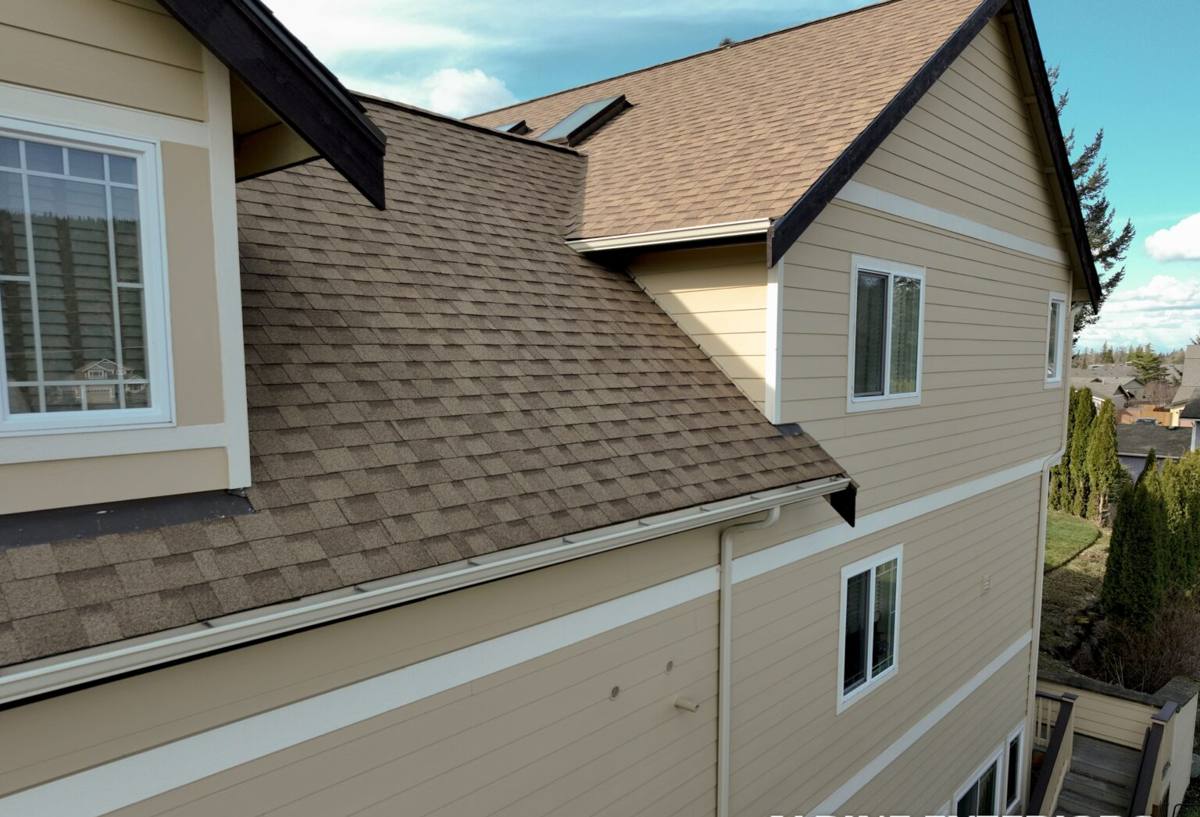
Fiber cement siding is a mix of cement, sand, and cellulose fiber, pressed and cured into planks or panels. It doesn't rot, it doesn't feed insects, and it doesn't expand and contract the way wood or vinyl does when temperatures swing. For a climate defined by prolonged dampness rather than extreme heat, those are the properties that matter most. It holds paint and factory finish far longer than wood because it isn't absorbing and releasing moisture the way a wood fiber does, and it isn't distorting the caulk lines and seams the way vinyl can.
It's also non-combustible, which is a real consideration as wildfire smoke and dry summer stretches have become a more regular part of the Pacific Northwest calendar, even on the wetter Eastside.
Why We Install Only James Hardie Fiber Cement
Fiber cement is a category, not a single product, and manufacturing quality varies. We install James Hardie exclusively — not Cemplank, not Allura — because Hardie engineers its siding by climate zone, backs it with a factory-baked ColorPlus finish, and offers a warranty structure that's genuinely transferable if the home sells. For Bellevue specifically, that means a product line engineered for the Pacific Northwest's moisture exposure (HardiePlank and HardiePanel in the HZ5 formulation), not a generic version of the same board sold in a dry climate.
We don't install LP SmartSide, vinyl, or primed wood siding, and we're upfront about why: those products can be installed correctly and can perform reasonably well, but each carries a maintenance burden or moisture vulnerability that we're not willing to put our name behind in this climate. Wood and wood-composite products need more frequent painting and caulk maintenance to keep water out at the seams. Vinyl's appearance and long-term performance are tied to a thinner material that's more prone to cracking, fading, and wind damage over a multi-decade span. Hardie's engineered fiber cement, installed to spec, is the product we've found holds up with the least maintenance and the fewest callbacks in this specific environment.
What a Correct Installation Looks Like
Fiber cement siding fails almost exclusively because of installation mistakes, not the material itself. In a climate with as much driving rain as Bellevue sees, the difference between a siding job that lasts decades and one that rots behind the boards within a few years comes down to details most homeowners never see once the job is finished.
Flashing and Water Management
Every window, door, and roofline intersection needs proper flashing and a drainage plane behind the siding — not caulk alone. Housewrap has to be lapped correctly, top over bottom, with flashing tape at every penetration. A rainscreen gap (a thin furring strip between the siding and the wall) is worth the extra step on Bellevue homes with heavy tree cover, since it lets any moisture that does get behind the boards actually dry out instead of sitting against the sheathing.
Fastening and Clearances
Hardie specifies exact nailing patterns, fastener types, and minimum clearances from grade, roofing, and decking — typically several inches of clearance to keep the bottom edge of the siding out of standing water and splash-back. Skipping these clearances is one of the most common shortcuts we see on jobs we're asked to inspect or repair, and it's usually where rot shows up first.
Joints, Caulking, and Butt Seams
Butt joints between planks need to be back-primed and properly sealed, not just butted together and caulked on the face. Face caulking alone looks fine for a year or two, then fails as the caulk shrinks and lets water track behind the board. Correct joint treatment is slower and less visible than a coat of caulk, which is exactly why it's the detail that separates a job installed to manufacturer spec from one that only looks right at handoff.
Fiber Cement vs. Other Siding Options for Bellevue Homes
| Material | Moisture Performance in This Climate | Maintenance | Typical Lifespan |
|---|---|---|---|
| James Hardie Fiber Cement | Engineered for wet climates (HZ5); dimensionally stable when wet | Occasional wash; ColorPlus finish resists fading and chalking | Multiple decades with correct install |
| Cedar / Primed Wood | Absorbs moisture at seams and end grain; prone to moss and rot in shade | Repainting and caulk renewal every few years | Shorter without diligent upkeep |
| Vinyl | Sheds water on the face but seams and J-channels can trap moisture | Low, but cracks and fades over time; hard to spot-repair invisibly | Variable; sensitive to impact and UV |
| LP SmartSide | Engineered wood strand product; performs well if edges stay sealed | Edge sealing and caulk maintenance are critical | Depends heavily on installation and upkeep |
This comparison reflects our professional experience and manufacturer specifications, not a claim that every alternative product fails. Each of these materials can perform when installed and maintained correctly. Our standard, for the moisture load Bellevue sees, is Hardie fiber cement — which is why it's the only product we put on a home.
Our Process, Start to Finish
- On-site assessment. We walk the exterior, check the existing water management, note shaded or moss-prone areas, and measure for material.
- Written scope and product selection. We go over plank profile, exposure, and ColorPlus color options, and put the scope of work in writing before anything is ordered.
- Tear-off and sheathing check. Old siding comes off and we inspect the sheathing underneath for any rot or damage that needs to be addressed before new siding goes on.
- Housewrap, flashing, and rainscreen. This is the water management layer that determines how the siding performs for the next several decades — it goes in before a single plank is hung.
- Installation to Hardie spec. Correct fastening, clearances, and joint treatment, following manufacturer installation guidelines for the HZ5 climate zone.
- Final walkthrough. We review the finished work with the homeowner and go over care and warranty registration.
Cost Factors for a Bellevue Fiber Cement Project
| Factor | Why It Affects Cost |
|---|---|
| Existing siding removal | Tear-off, sheathing repair, and disposal add labor beyond a straightforward re-side |
| Home size and wall complexity | Cut-ups, dormers, and multiple stories increase both material and labor time |
| Trim and accent details | Board-and-batten accents, trim boards, and color changes between fields add labor |
| Access and site conditions | Steep lots, mature landscaping, and limited staging space common on Eastside properties can slow the job |
| Product line and finish | HardiePlank, HardiePanel, and HardieShingle carry different material costs and installation time |
We don't quote a project without walking the site, and we won't give a ballpark number that ignores tear-off condition or wall complexity — those two factors move the price more than anything else on a typical Bellevue home.
Living With Fiber Cement Through Moss Season
Even the right siding needs some basic care in a climate with a long moss season. Fiber cement won't feed moss the way wood does, but algae and moss can still take hold on the surface in shaded, damp areas, especially on north-facing walls or under tree canopy. A rinse with a garden hose once or twice a year, keeping gutters clear so water isn't sheeting down the wall face, and trimming back vegetation that keeps siding in constant shade will keep the surface looking clean without any special treatment. Because ColorPlus is a factory-applied finish baked onto the board, it holds color and resists the chalking and fading that make repainting necessary on wood siding — one less maintenance cycle to manage through the wet season.
- Rinse siding annually, more often on shaded or north-facing walls
- Keep gutters and downspouts clear so water isn't running down the wall face
- Trim back shrubs and trees holding moisture against the siding
- Re-caulk at trim and penetrations if a joint ever looks cracked or gapped
- Watch the bottom courses near grade and decking for splash-back staining
Why a Crew That Already Works Bellevue Matters
Installation quality is the single biggest variable in how fiber cement siding performs, and installers who work King County regularly build a feel for the details that matter here — clearance from grade on a sloped Eastside lot, rainscreen decisions on a heavily shaded wall, flashing sequencing around windows that face the prevailing weather. A crew that mostly installs in a drier climate and treats every job the same way is more likely to skip the details that don't cause problems for a year or two but show up as rot and callbacks down the line. Local also means a faster response if something needs a look after a storm, and a crew that's still around — and still reachable — years after the job is done.
If you're planning a siding project in Bellevue, we're happy to walk the exterior, look at what's there now, and talk through what a correct Hardie installation would involve for your home. There's no cost and no pressure to get a written estimate — just a straight assessment from a crew that installs this product, and only this product, throughout King County.