 King County
 Why Ballard Roofs Take a Different Kind of Beating
Ballard sits close to the water, and that changes what a roof has to deal with over its lifetime. Wind off Puget Sound doesn't just blow rain sideways — it drives it up and under roofing edges, flashing laps, and ridge caps at angles a roof designed for straight-down rainfall was never built to shed. Add the salt content in that air, and you get faster corrosion on exposed metal flashing, fasteners, and vent stacks than you'd see further inland in King County. It's slow, and it's easy to miss until a storm finds the weak point.
Then there's the tree cover. Ballard's mix of mature evergreens and big-leaf maples means shade, falling debris, and roofs that stay damp longer after every rain than a roof out in the open would. That damp holds moss, and moss season here isn't a week or two — it's most of the year. A roof that's already carrying a moss mat and some trapped moisture is in much worse shape to handle a wind event than a clean, dry one. Storm damage on a Ballard roof is rarely just about the storm — it's usually the storm exposing something the local climate had already been working on for months.
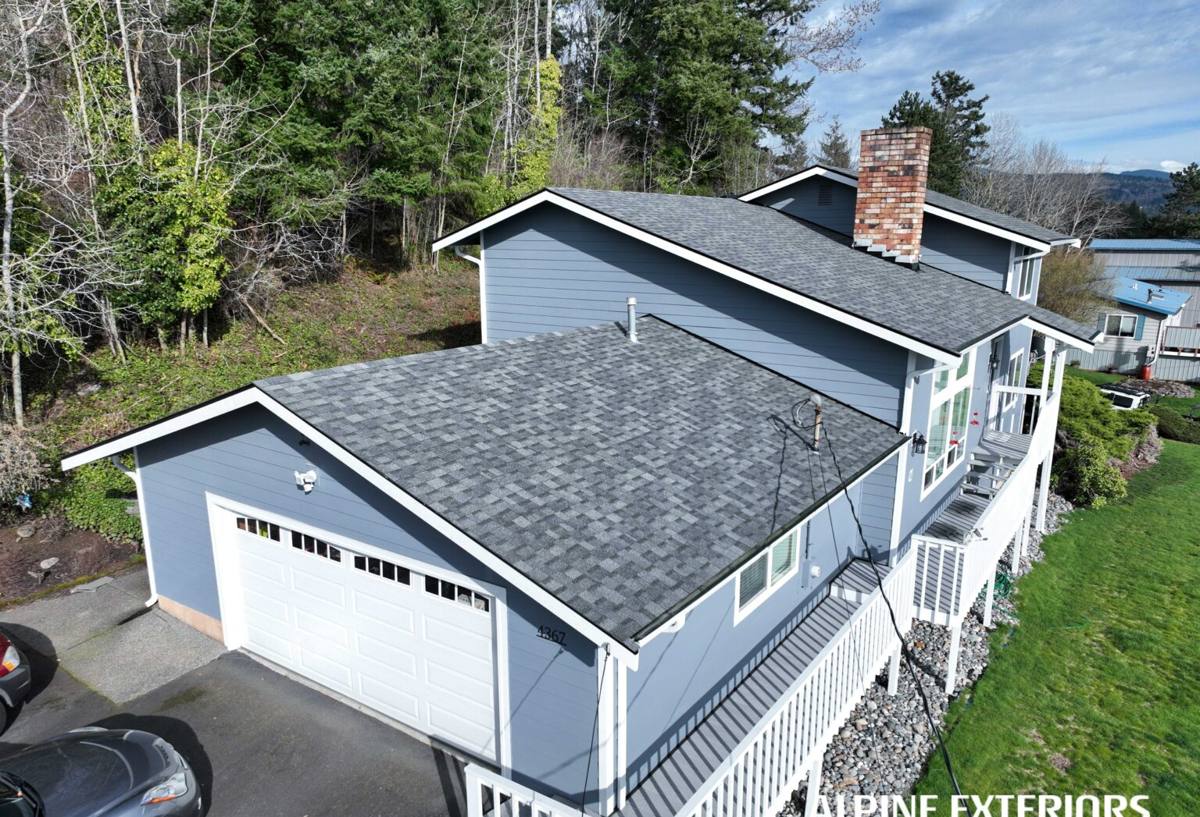
What Actually Counts as Storm Damage
Homeowners often picture storm damage as something dramatic — a tree through the roof, a hole you can see from the yard. Most of what we get called out for in Ballard is quieter than that:
- Wind uplift on shingle tabs or ridge caps, where the seal has broken and wind gets underneath, lifting and cracking the shingle without tearing it off entirely
- Impact damage from branches or debris carried by wind, which can bruise or crack shingles without leaving an obvious hole
- Flashing separation at chimneys, valleys, and sidewalls — this is where wind-driven rain gets in even when the shingles themselves look fine
- Displaced or cracked hip and ridge caps, often the first thing to go in a sustained windstorm
- Granule loss from wind abrasion, which shortens the life of the shingle underneath even though nothing looks visibly "broken"
The tricky part is that most of this isn't visible from the ground. A roof can look intact after a storm and still be letting water in at a seam.
Signs You Need a Storm Damage Inspection
If Ballard has just been through a windstorm or a stretch of hard, driving rain, these are the things worth checking — or having us check — before small damage turns into a bigger repair:
- Shingles that look curled, lifted, or missing when viewed from the street or yard
- Granules collecting in gutters or at the base of downspouts after a windy week
- New water stains on ceilings or upper interior walls, especially near exterior corners
- Drafts, daylight, or a musty smell in the attic that wasn't there before
- Moss mats thick enough to hold standing water after rain stops
- Flashing around the chimney, plumbing vents, or skylights that looks loose, rusted, or separated
- Any visible sagging in a roof section, even a slight dip
None of these guarantee major damage — but any one of them is a reason to get eyes on the roof before the next storm rolls through.
What a Correct Storm Damage Repair Actually Involves
Assessment Before Any Work Starts
A repair is only as good as the inspection behind it. We look at the whole roof system, not just the spot that's obviously damaged — because wind and rain damage tends to show up downstream of where it actually entered. A leak stain in one room can trace back to flashing several feet away. We also check the attic side when it's accessible, since that's often where you see the real extent of water intrusion before it ever reaches a ceiling.
Matching Materials and Technique
Patching a roof with mismatched shingles or the wrong nailing pattern is a common shortcut that causes repeat leaks. We match shingle type, weight, and where possible, color, and we install with the same nailing pattern and exposure the original roof used — not just enough fasteners to hold it down for now.
Flashing and Underlayment — Not Just Shingles
Most of the storm-driven leaks we see in Ballard trace back to flashing, not the shingle field itself. A correct repair means resealing or replacing flashing at valleys, chimneys, and sidewalls, and checking the underlayment underneath the damaged section — because if wind-driven rain got past the shingle, it may have already reached the underlayment too. Replacing shingles over compromised underlayment just delays the next leak.
Moss and Debris Removal Done Right
Moss removal is part of a lot of Ballard storm repairs, since moss that's been trapping moisture is often what weakened the area a storm then damaged further. We remove it by hand and treat the area rather than pressure-washing, which strips protective granules and can shorten the life of the shingles you're trying to save.
Our Process, From Call to Completion
- Initial call or photos — a quick description or a few photos usually tells us whether this needs urgent attention (active leak, exposed decking) or can be scheduled normally
- On-site inspection — we walk the roof and check the attic where possible, and if there's active water intrusion, we'll tarp or otherwise stabilize the area first
- Written scope and estimate — what we found, what needs to happen, and what it costs, before any repair work begins
- Repair, scheduled around the weather — storm repairs need a dry work window, so we schedule around forecasts rather than rushing a patch in the rain
- Cleanup and walk-through — debris cleared, and we show you what was done and why
Repair or Replacement? What Actually Drives the Decision
Not every storm-damaged roof needs to be replaced, and not every roof is worth patching. The honest answer depends on a few factors:
| Factor | Leans Toward Repair | Leans Toward Replacement |
|---|---|---|
| Roof age | Under roughly half its expected lifespan | Near or past its expected lifespan |
| Extent of damage | Isolated to one section or feature | Spread across multiple areas or slopes |
| Underlayment condition | Dry and intact where checked | Saturated or deteriorated in multiple spots |
| Repair history | First or second repair in this area | Same section has been patched repeatedly |
| Material availability | Matching shingles are still obtainable | Original material is discontinued and won't match |
We'll always tell you honestly which side of that table your roof falls on, including when a repair is the right call even though a replacement would be more profitable for us.
Working With Insurance on Storm Claims
If a windstorm caused the damage, homeowners insurance may cover part or all of the repair, depending on your policy. We can document the damage with photos and a written estimate that you can submit to your carrier, and we're happy to answer a claims adjuster's questions about the scope of work. What we won't do is promise a claim will be approved or inflate a scope to fit a settlement — that's between you and your insurer, and it's not a service we'll misrepresent. Documenting damage as soon as possible after a storm, before further rain or wind makes it worse, is the biggest thing in your control.
Why Hiring a Crew That Already Works Ballard Matters
Ballard's housing stock is a mix — older craftsman-style homes with steeper, more complex rooflines sitting next to newer infill construction with simpler, sometimes lower-slope roofs. Repairing each correctly means knowing which techniques and materials actually belong on that roof type, not applying a one-size approach. Density here also means tighter lots, limited staging space, and parking that takes some local know-how to work around efficiently — all things that slow down a crew unfamiliar with the neighborhood and add time (and cost) to a job that should be straightforward.
A crew that's already doing this work across King County and specifically in neighborhoods like Ballard also has a better read on how a given storm likely affected roofs nearby, which speeds up diagnosis. That familiarity doesn't replace a real inspection, but it does mean fewer surprises and a faster path from "we have a leak" to "it's fixed."
Preventing Repeat Damage After the Repair
A repair holds up better when a few basic maintenance habits go with it:
- Clear gutters and downspouts at least twice a year, more often under heavy tree cover
- Address moss buildup before it becomes a thick mat, not after
- Trim back branches that overhang the roofline where it's safe to do so
- Have the roof looked at after any major windstorm, even if nothing looks obviously wrong
- Keep a record of past repairs so any contractor working on the roof later knows its history
None of this prevents every storm from causing damage, but it closes off the weak points storms tend to exploit — which is most of what separates a minor repair from a major one.
If Ballard's latest windstorm or wet stretch has you wondering about your roof, we're glad to take a look. Estimates are free, there's no pressure to sign anything on the spot, and you'll get a straight answer about whether you're looking at a repair or something bigger — you can request one using the form below.