 King County
 Building a Deck That Actually Holds Up in Bellevue
Bellevue sits in one of the wetter corners of King County, and a deck here does a different job than a deck in a dry climate. It's not just outdoor furniture with a view of the yard — it's an exterior structure that spends most of the year damp, shaded by mature trees in a lot of neighborhoods, and exposed to long stretches of low sun angle that never quite dries the boards out. A deck built without that in mind might look fine for a season or two. Five years in, the problems show up: soft spots underfoot, green film on the boards every spring, ledger boards that have been quietly rotting behind the siding the whole time.
We build decks in Bellevue and across King County the way the climate actually demands, not the way a generic framing plan assumes. That means paying more attention to drainage, fastener choice, and substructure ventilation than you'd need to in a drier region, and being honest with homeowners about which materials and details are worth the extra cost here.
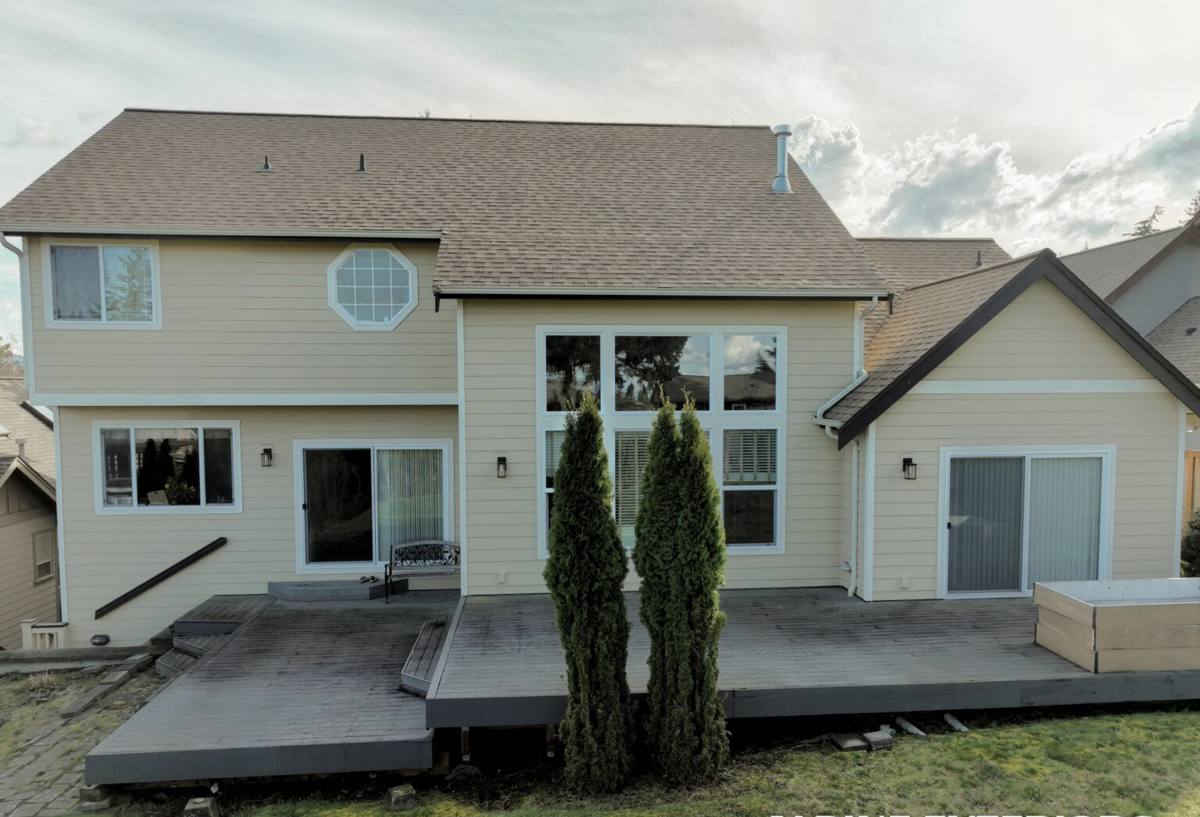
What King County's Climate Does to a Deck Over Time
Western Washington's marine climate is the defining fact of any outdoor structure in this region. King County sees driving rain for months at a stretch, humidity that lingers even on dry days, and a moss season that can run from fall through spring. Areas closer to Puget Sound also deal with salt-laden air working into fasteners and finishes over time — a factor that matters less in Bellevue specifically, since it sits inland from the Sound around Lake Washington and Lake Sammamish, but the broader pattern of near-constant moisture is exactly the same here.
For a deck, that moisture shows up in a few predictable ways:
Moss and Algae on Horizontal Surfaces
Any flat, shaded surface in King County grows moss and algae if it doesn't dry out regularly. Deck boards are about as flat and often about as shaded as it gets, especially under mature Douglas fir or cedar canopy common in Bellevue yards. Moss holds moisture against the board surface, and on wood decking that accelerates rot; on composite decking it mostly creates a slip hazard and a maintenance chore.
Hidden Rot at Connection Points
The failures we see most often aren't in the visible boards — they're in the framing underneath: ledger boards bolted to the house, joist ends, post bases sitting in standing water. These spots trap moisture longer than open-air surfaces and are exactly where a deck loses structural integrity years before it looks bad from above.
Fastener and Hardware Corrosion
Constant dampness accelerates corrosion in any fastener or connector that isn't rated for exterior, wet-climate use. Once a fastener starts to fail, the joint around it starts moving, which opens up more paths for water — a slow-motion problem that's cheap to prevent up front and expensive to fix later.
Choosing the Right Decking Material for This Climate
There's no single "best" decking material — there's a best material for a given budget, maintenance appetite, and exposure. In a climate like King County's, the trade-offs are sharper than they'd be somewhere dry.
| Material | How It Handles Our Climate | Maintenance | Typical Lifespan |
|---|---|---|---|
| Pressure-treated lumber | Affordable and workable, but needs consistent sealing to resist the constant moisture; end grain and fastener holes are the weak points | Annual cleaning, re-sealing every 1-2 years | 10-15 years with upkeep |
| Cedar | Naturally rot-resistant and a good visual fit for the Pacific Northwest, but softer and more prone to surface checking under repeated wet-dry cycles | Regular cleaning, periodic oil or stain | 15-20 years with upkeep |
| Composite decking | Doesn't absorb water or rot, handles moss and algae better once cleaned, holds up well to our shade-and-damp combination | Periodic washing, no sealing required | 25-30+ years, manufacturer-warrantied |
| PVC decking | Fully synthetic, essentially immune to moisture damage; performs consistently in shaded, damp yards | Occasional washing | 25-30+ years, manufacturer-warrantied |
We install all of these depending on the homeowner's budget and priorities. Our professional standard is that whatever material goes down, the framing underneath and the fasteners holding it together have to match that material's expected lifespan — there's no point putting a 30-year composite board over framing that was detailed for a 12-year deck.
Framing and Substructure: Where Failures Actually Start
Most deck problems homeowners call us about aren't the decking boards at all — they're the structure underneath, and it's the part that's easiest to build wrong because it's the part nobody sees once the project is finished.
Ledger Board Attachment
The ledger board — where the deck bolts into the house — is the single most important connection on the whole structure, and it's the one most exposed to water running down the siding. Proper flashing behind and over the ledger, with a gap or drainage path so water can't pool between the deck and the house, is non-negotiable in a climate this wet.
Joist Protection
Joist tape or an equivalent moisture barrier over the top of each joist keeps water from soaking into end grain through fastener holes — the exact spot where hidden rot usually starts. It's a small material cost that pays for itself many times over in a climate that rarely lets wood dry out completely.
Post Bases and Footings
Posts need to sit above grade on proper post bases, not buried in soil or sitting in a low spot that collects runoff. Footings need to be sized and set below frost depth per code, and positioned so water sheds away from them rather than pooling at the base.
Drainage and Grading Around the Deck
A deck doesn't exist in isolation — it sits in a yard, and how that yard drains determines how long the structure underneath lasts. In King County's rainfall pattern, a deck built over ground that doesn't drain is a deck that spends winter with damp framing no matter how well the deck itself was built.
Before we frame anything, we look at how water moves across the site: whether the ground slopes away from the house, whether gutters and downspouts dump near the deck footprint, and whether a low-clearance deck needs a drainage system underneath to keep the space below usable and dry. On lower decks especially, an under-deck drainage membrane can turn unusable damp storage space into dry, functional area — worth discussing if that space matters to you.
Permits and Code Requirements
Most new decks and many substantial deck replacements in Bellevue and King County require a building permit, with inspections at key stages such as footings and framing before the decking goes down. Requirements depend on the deck's height, size, and attachment to the house, and they exist for a good reason — an under-built deck is a safety issue, not just a code technicality.
We handle permitting as part of the job rather than treating it as the homeowner's problem to sort out. A contractor who suggests skipping permits to save time is asking you to take on liability that should sit with the builder, not with you.
Our Deck Building Process
Every deck we build in Bellevue follows the same basic sequence, adjusted for the specific site and material:
- Site evaluation and design — assessing grade, sun exposure, tree canopy, and how the deck will attach to the house
- Material selection — walking through the honest trade-offs above based on budget and maintenance preference
- Permitting — submitting plans and scheduling required inspections
- Footings and framing — setting posts and footings below frost depth, framing with moisture protection at every connection point
- Ledger attachment and flashing — the most critical connection, detailed to keep water out of the house structure
- Decking installation — spacing and fastening appropriate to the material, with attention to how the boards will handle wet-dry cycling
- Railing, stairs, and finish work — built to current code for height and baluster spacing
- Final walkthrough — confirming everything is solid, level, and ready for inspection sign-off
Maintenance: What Owning a Bellevue Deck Actually Requires
Whatever material you choose, a King County deck needs some seasonal attention to reach its full lifespan. A short, honest checklist:
- Clear leaves and debris from between boards before fall rains set in — trapped debris holds moisture against the deck surface
- Wash the deck surface at least once a year to remove moss and algae buildup before it gets a foothold
- Check and clear any drainage paths or scuppers on low-clearance or covered decks
- Inspect fasteners, railings, and stair connections annually for movement or corrosion
- For wood decks, re-seal or re-stain on the schedule the product calls for — don't wait until it looks dry
- Keep gutters and downspouts near the deck clear so runoff isn't draining onto or under the structure
Why Hiring a Crew That Already Works Bellevue Decks Matters
Deck-building fundamentals don't change by zip code, but the details that determine whether a deck lasts 10 years or 30 do change with climate. A crew that mostly builds in drier regions may not default to joist tape, may not flash a ledger board as aggressively, or may not think through drainage under a low deck — because in their climate, those shortcuts don't get punished as quickly. In King County, they get punished within a few wet winters.
We build decks throughout Bellevue and the surrounding King County area, and we detail every one for the climate it's actually going to sit in — not a generic national standard. That's the difference between a deck that needs real repair work in year eight and one that's still solid at year twenty-five.
If you're planning a new deck or replacing one that's showing its age, we're happy to take a look and walk you through your options. Reach out for a free, no-pressure estimate using the form below.