 King County
 Siding Built for How Bellevue Actually Weathers
Bellevue sits in a part of King County where the exterior of a house works hard for a living. Long stretches of driving rain move through in fall and winter, moisture-tinged air rolls in off Puget Sound and Lake Washington, and the tree canopy that makes Bellevue's neighborhoods so pleasant also means shade, damp air, and a moss season that can run most of the year in the wrong spot on a house. None of that is exotic — it's just the Pacific Northwest doing what it does. But it means siding here isn't a cosmetic decision. It's a system that either sheds water and resists organic growth, or it doesn't, and the difference shows up in five years, not fifty.
We install James Hardie fiber cement siding exclusively. We don't offer vinyl, LP SmartSide, Cemplank, Allura, primed spruce, or cedar as alternatives, and on a page like this it's worth explaining why, specifically for a Bellevue house, rather than just asserting it.
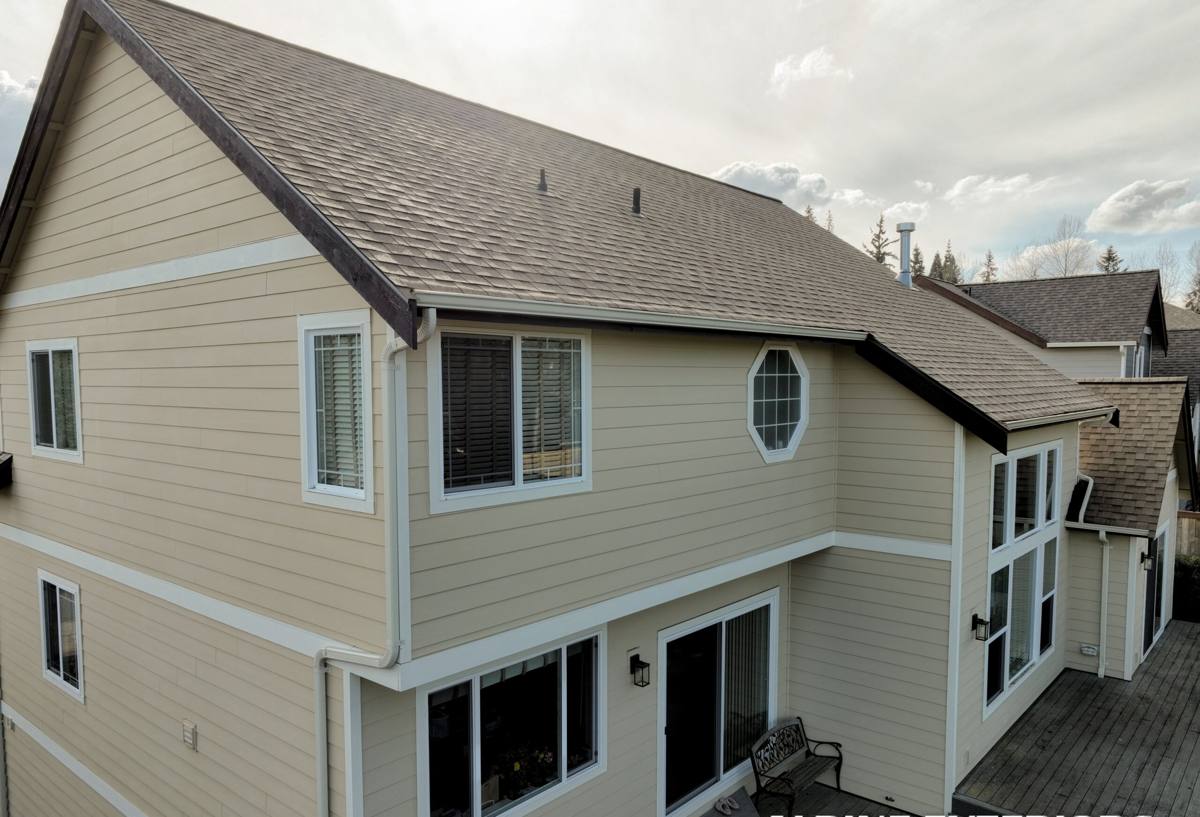
What King County's Climate Actually Does to Siding
Moisture, Not Just Rain
The problem in this region isn't a single downpour — it's sustained dampness. Wood-based siding products and their trim absorb moisture at cut edges, fastener holes, and joints, and if that moisture doesn't fully dry out between weather systems, it starts a slow cycle of swelling, checking, and paint failure. Vinyl doesn't absorb water the same way, but it flexes with temperature swings and can gap at seams, giving wind-driven rain a path behind the cladding where it has nowhere to go.
Moss, Algae, and Shade
North-facing walls, siding tucked under eaves or mature trees, and anything that stays shaded through the short winter days will grow moss and algae faster here than almost anywhere else in the country. That growth holds moisture against the siding surface, which accelerates whatever weakness the material already has. A siding product's real test in King County isn't how it looks on day one — it's how it looks on a shaded north wall five winters in.
Salt-Tinged Air
Proximity to Puget Sound means the regional air carries more salt and moisture than an inland climate, which is harder on fasteners, caulking, and any siding product that relies on paint film alone for protection. Factory-cured finishes hold up differently than field-applied paint under that kind of exposure.
Why We Standardized on James Hardie
James Hardie fiber cement is cement, sand, and cellulose fiber, cured into a dense, dimensionally stable board. It doesn't absorb and swell the way wood-based products do, it's non-combustible, and Hardie's ColorPlus finish is baked on at the factory under controlled conditions rather than painted on site — which matters in a climate where field-applied paint has fewer good drying windows per year. Hardie also engineers specific product lines (their HZ5 designation) for climates like the Pacific Northwest, accounting for the freeze-thaw and moisture cycling this region sees.
We're not going to tell you every other product is worthless — that's not honest and it's not our call to make about a manufacturer's engineering. What we will say is that after years of installing and repairing siding on King County homes, we stopped offering the alternatives because we were tired of watching them fail here in ways they might not fail in a drier climate. That's a standard we hold, not a claim about what's on your neighbor's house.
How the Alternatives Actually Compare Here
| Material | How it handles King County moisture | Long-term consideration |
|---|---|---|
| Vinyl siding | Doesn't absorb water, but seams and panel flex can let wind-driven rain behind the cladding | Can warp or fade with UV and temperature cycling; harder to repair invisibly |
| LP SmartSide / engineered wood | Treated to resist moisture, but cut edges and fastener points remain vulnerable if not perfectly sealed and maintained | Relies on ongoing caulk and paint maintenance to keep performing |
| Cedar / primed spruce | Natural material, absorbs and releases moisture constantly; moss and mildew take hold quickly in shaded areas | Needs frequent refinishing; highest long-term maintenance in this climate |
| James Hardie fiber cement | Dimensionally stable, doesn't swell or rot, factory finish resists the region's moisture and salt air | Correct installation (gaps, flashing, fastening) is what determines lifespan |
What a Correct Bellevue Installation Actually Involves
Hardie siding's performance is only as good as the install underneath it. This is true everywhere, but it matters more in a climate that doesn't give a bad install many chances to dry out.
- Water-resistive barrier and flashing first. The siding is the last line of defense, not the only one. Proper house wrap, window and door flashing, and kick-out flashing at roof-wall intersections have to be right before a single board goes up.
- Correct gapping and clearances. Hardie specifies gaps at butt joints, trim, and adjacent surfaces so the material can move seasonally without trapping water. Installers who tight-fit boards to make a cleaner-looking seam are setting up moisture problems.
- Fastening to spec. Fastener type, spacing, and depth all affect how the siding holds up to wind-driven rain and how well it resists working loose over time.
- Ground clearance and drainage. Siding installed too close to grade, decks, or roof lines stays damp longer — a common problem on older Bellevue homes that we address when we replace siding.
- Caulking only where Hardie's install guide calls for it. Over-caulking gaps that are supposed to allow movement and drainage traps water instead of shedding it.
Our Process for Bellevue Homeowners
1. On-Site Assessment
We look at your home's specific exposure — which walls take the worst weather, where moss has already taken hold, where trim and flashing show signs of past moisture problems — before we talk product selection or price.
2. Scope and Product Line
We walk through which James Hardie product line and profile fits your home, and explain the climate-specific reasoning, not just the color and style options.
3. Prep and Water Management
Any compromised sheathing, damaged flashing, or house wrap issues get addressed before new siding goes up. Covering up an existing moisture problem with new siding just delays the failure.
4. Installation to Manufacturer Spec
Gapping, fastening, and flashing detail follow James Hardie's published installation requirements — which is also what keeps the manufacturer's warranty intact.
5. Final Walkthrough
We go over the finished work with you directly, including how to care for the siding going forward.
Why a Crew That Already Works Bellevue Matters
Siding installation isn't just following a manual — it's judgment calls about flashing details on a specific roofline, how much clearance a specific deck ledger needs, and which walls on a specific lot are going to fight moss for the life of the product. A crew that regularly works King County homes has already made those calls dozens of times in conditions that match what your house is dealing with. That experience shows up in the details a first-time or out-of-area installer is more likely to miss — the ones that don't cause a problem in year one, but do in year five.
Maintenance: What Bellevue Homeowners Should Actually Expect
Correctly installed James Hardie siding is low-maintenance, not no-maintenance. A realistic yearly routine:
- Rinse siding to keep moss and algae from establishing, especially on shaded or north-facing walls
- Check caulking at trim and penetrations for cracking or gaps, and have it addressed before winter rains
- Keep gutters clear so overflow isn't running down the siding face
- Trim back vegetation that keeps a wall shaded and damp
- Watch for any soft spots, staining, or discoloration near ground level or roof intersections
What This Costs
Cost depends on your home's size, the number of stories, existing siding removal, trim complexity, and product line selection. In general terms, factors that move the price:
| Factor | Why it affects cost |
|---|---|
| Tear-off vs. new construction | Removing and disposing of existing siding adds labor and dump fees |
| Home height and access | Multi-story homes and difficult access require more scaffolding and time |
| Trim and architectural detail | More corners, windows, and trim lines mean more cutting and fitting labor |
| Product line and profile | Hardie's various lines and plank widths carry different material costs |
| Underlying repairs | Sheathing or flashing damage found during tear-off needs to be fixed before new siding goes up |
We give exact numbers only after seeing the house — anything else is a guess that helps no one.
If you're weighing a siding project on a Bellevue home, we're happy to walk the exterior with you and give you a straight, no-pressure estimate. Use the form below to get started.