 King County
 What "New-Construction Windows" Actually Means
New-construction windows are not the same product as the replacement windows most homeowners are familiar with. A new-construction window has a nailing flange (also called a nail fin) built into the frame, which gets fastened directly to the sheathing before siding goes on. That flange is what ties the window into the wall's water management system — it's not just a mounting method, it's a flashing component. Replacement windows, by contrast, are built without a flange so they can be inserted into an existing frame without disturbing the exterior wall.
On a new build or an addition in Rainier Valley, you have the framing exposed and the weather-resistive barrier (WRB) either freshly installed or about to go on. That's the one window in a home's life where the installer has full access to the rough opening, the sheathing, and the flashing plane at the same time. Getting it right at this stage matters more than at almost any other point in the build, because once the siding goes up, those flashing layers are hidden for decades.
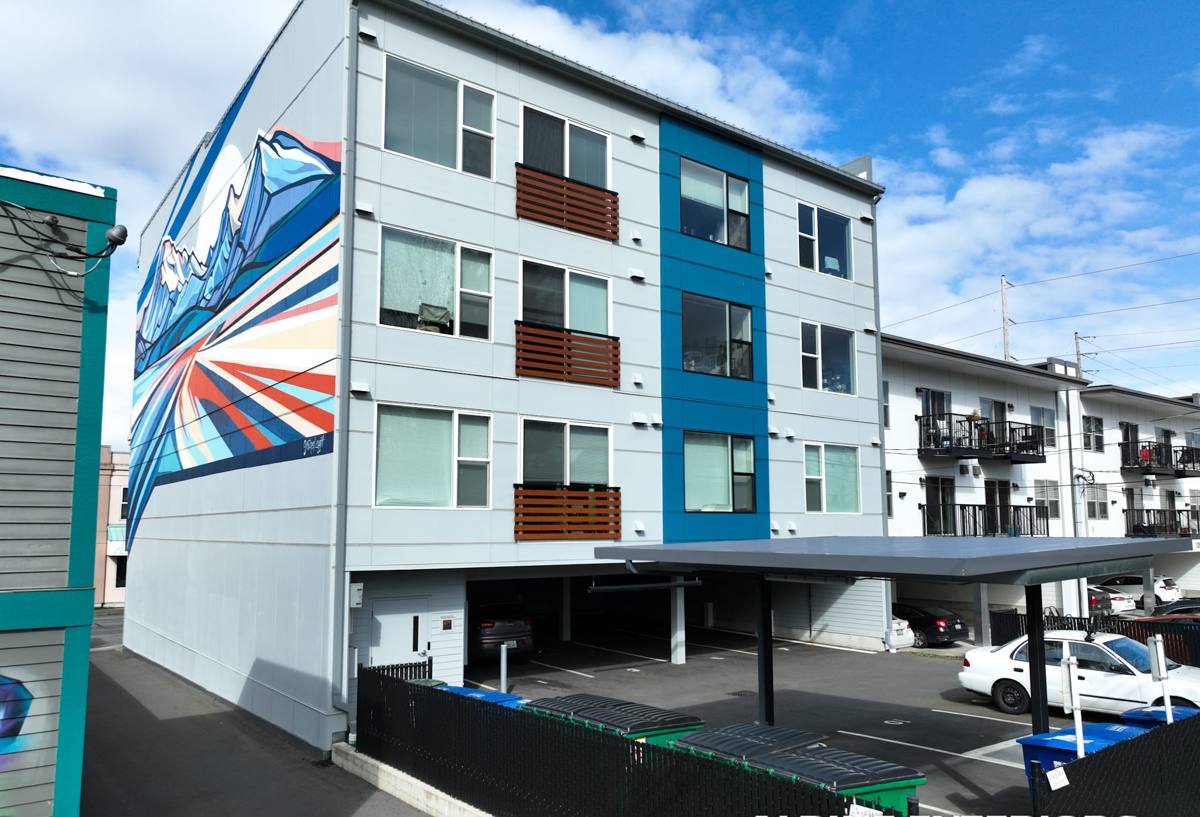
Why Rainier Valley's Climate Raises the Stakes
King County homes deal with a specific combination of conditions: long stretches of steady rain, periods of wind-driven rain that pushes water sideways and upward against a wall rather than just down it, and a moss season that runs most of the year on shaded or north-facing elevations. None of that is exotic for the Puget Sound region, but it's exactly the combination that exposes a window install done with shortcuts. A rough opening that's slightly out of square, a sill pan that wasn't sloped correctly, or house wrap that was lapped the wrong direction won't show a problem in dry weather. It shows up during the first real driving-rain event, usually as a stain on the interior sill or, worse, inside the wall cavity where nobody sees it until there's rot.
Salt-tinged air off the Sound also plays a role for homes closer to the water — it accelerates corrosion on unprotected fasteners and hardware, which is one more reason to use flashing tapes, fasteners, and frame materials rated for a marine-influenced climate rather than a generic interior-grade builder spec.
The Install Sequence That Prevents Leaks
Sill Pan and Flashing
Every new-construction window opening should get a sloped sill pan before the window ever goes in. The pan directs any water that gets past the window — and over enough decades, some always will — back outside instead of into the framing. We form or install a pan that slopes slightly toward the exterior, dress the corners so there's no seam for water to find, and only then set the window.
Integrating with the Weather-Resistive Barrier
The WRB has to lap correctly with the window flange in a specific order: sill first, then jambs, then head, shingle-style, so gravity always carries water over a layer that's beneath it, never into a layer that's above it. This is the step where an installer who doesn't do this daily tends to reverse the order or skip a layer to save time. It's invisible once the siding is on, which is exactly why it has to be checked at install, not assumed.
Sealant — Where It Belongs and Where It Doesn't
A common mistake is sealing the bottom flange of the window solid to the sheathing. That traps any water that does get behind the siding with nowhere to drain, which is the opposite of what you want. Sealant belongs at the sides and top, where it blocks air and bulk water intrusion, while the sill stays a drainage plane rather than a dam.
Choosing Frame Material for This Climate
There's no single "best" window frame material — the right choice depends on budget, the home's exposure, and how much upkeep you want to take on. Here's how the common options stack up for a wet, moderate King County climate:
| Frame Material | Moisture Behavior | Maintenance | Typical Fit |
|---|---|---|---|
| Vinyl | Won't rot; expands/contracts with temperature swings | Low — occasional cleaning | Budget-conscious builds, rentals, most new construction |
| Fiberglass | Excellent — dimensionally stable, low expansion | Low | Larger openings, higher-end new construction |
| Wood-clad (exterior clad, wood interior) | Good on the clad face; interior wood needs interior humidity control | Moderate — interior finish upkeep | Homes prioritizing interior wood aesthetic |
| Aluminum | Prone to condensation without thermal breaks; can corrode near salt air without proper coating | Moderate — watch fasteners and finish | Commercial-style sightlines, not our default residential recommendation here |
For most Rainier Valley new-construction projects, we steer homeowners toward vinyl or fiberglass because both handle sustained moisture exposure with minimal upkeep. Aluminum without a proper thermal break and marine-grade coating is a harder sell this close to the Sound — it's not that the material is bad, it's that it demands more maintenance vigilance than most homeowners want to sign up for.
Glazing and Performance for a Wet, Mild Climate
King County's climate is mild compared to much of the country — we're not fighting extreme cold — but we are fighting near-constant moisture and long gray stretches with limited solar gain. Low-E glazing helps retain interior heat during our cool, wet months without over-optimizing for a heat load that Rainier Valley rarely sees. Argon-filled double-pane units are the standard baseline for new construction here; triple-pane is worth discussing on north-facing or particularly exposed elevations, but it's an added cost that isn't always necessary given our climate profile.
Coordinating with Your Builder or GC
New-construction window installation isn't a standalone trade — it sits between the framer, the WRB/house-wrap installer, and the siding crew. Timing matters: windows typically go in after the WRB is applied but before siding starts, and the flashing sequencing has to be coordinated so nobody laps a layer the wrong way to hit a schedule. When we're brought in on a build, we coordinate directly with the general contractor or framing crew on sequencing so the window and wall system work together as one continuous water-management plane, not two separate jobs that happen to meet in the middle.
Common Mistakes We See (and Fix)
- Sill pans skipped entirely or installed flat instead of sloped
- House wrap taped in the wrong lapping order around the opening
- Bottom flange fully sealed, blocking drainage
- Rough openings left out of square, forcing the window frame to rack under fastening
- Shims left uncompressed, allowing the frame to bow and stress the seal
- Exterior trim installed tight against the frame with no room for the window to expand and contract
Every one of these is easy to miss on a walkthrough and expensive to trace back to once siding and interior finish are done. That's why we treat window flashing as an inspection point during the build, not an afterthought.
Our Process for New-Construction Window Jobs
- Review the rough openings for square, level, and correct sizing before any window arrives on site
- Install sloped sill pans at every opening
- Set windows plumb, level, and square, shimmed and fastened per manufacturer spec
- Integrate flashing tape with the WRB in proper shingle-lap order — sill, jambs, head
- Seal jambs and head; leave the sill drainage path open
- Photograph the flashing sequence at each opening before siding covers it, for our records and yours
- Coordinate exterior trim and siding tie-in so the water plane stays continuous from roof to foundation
Why a Siding-and-Window Crew Matters in Rainier Valley
Most window leaks don't happen at the glass — they happen at the transition where the window meets the siding, trim, and WRB. When one crew installs the windows and a different crew installs the siding weeks later, that transition is the one place where nobody owns the whole picture. We install both, which means the same crew that sets the sill pan and laps the flashing is also the crew that ties the siding into it. There's no handoff where details get lost, and no argument later about which trade is responsible for a leak at that seam. For a climate that includes salt-laden air, driving rain, and a moss season that never fully lets up, that continuity is what actually keeps water out over the long run — not any single product choice.
If you're planning new construction or an addition in Rainier Valley and want windows installed by a crew that treats flashing and drainage as seriously as the glass itself, we're happy to walk your plans and give you a straightforward, no-pressure estimate. Reach out using the form below.